Author: G.Aydin, H.Ege

88% of senior sport executives say they are confident in AI adoption. Yet cross-sector research shows only 5% of employees actually use AI in ways that transform their work. The gap between confidence and capability is not a technology problem. It is a literacy problem.
Inside European sport, the structural picture is sharper still. The EU AI Act's Article 4 made AI literacy a legal obligation from February 2025. National market surveillance authorities begin enforcing this from August 2026. The Union of Skills, launched in March 2025, has placed AI literacy at the centre of Europe's competitiveness agenda. The OECD and European Commission released the AILit Framework draft in May 2025. Sport sector responses to all of these frameworks are still forming.
Coaches are beginning to explore generative AI tools while organisational guidance is still taking shape. Federation administrators procure AI systems without internal audit capacity. Volunteers running grassroots clubs operate as deployers under Article 4 with no infrastructure to support them. Athletes consent to data terms they have limited capacity to evaluate.
Using our SF4Sport methodology, we focused on this space. The work involved three interconnected layers:
Environmental scanning: identifying signals of change, emerging trends and potential wild cards across the AI literacy and sport sector landscape.
Policy alignment: mapping findings against EU policy frameworks including the EU AI Act (Regulation 2024/1689), the Union of Skills, DigComp 2.2, the AILit Framework, Erasmus+ 2026 and the EU Work Plan for Sport 2024 to 2027.
Evidence synthesis: reviewing peer-reviewed academic sources alongside institutional reports from the OECD, the European Commission, N3XT Sports, EY, McKinsey and others.
The picture that emerged is clear: across European sport, AI is being adopted faster than the literacy needed to use it well is being built. Here are 5 signals, 3 trends and 2 wild cards likely to shape the future.
Signal 1: AI Adoption Is Outpacing AI Literacy
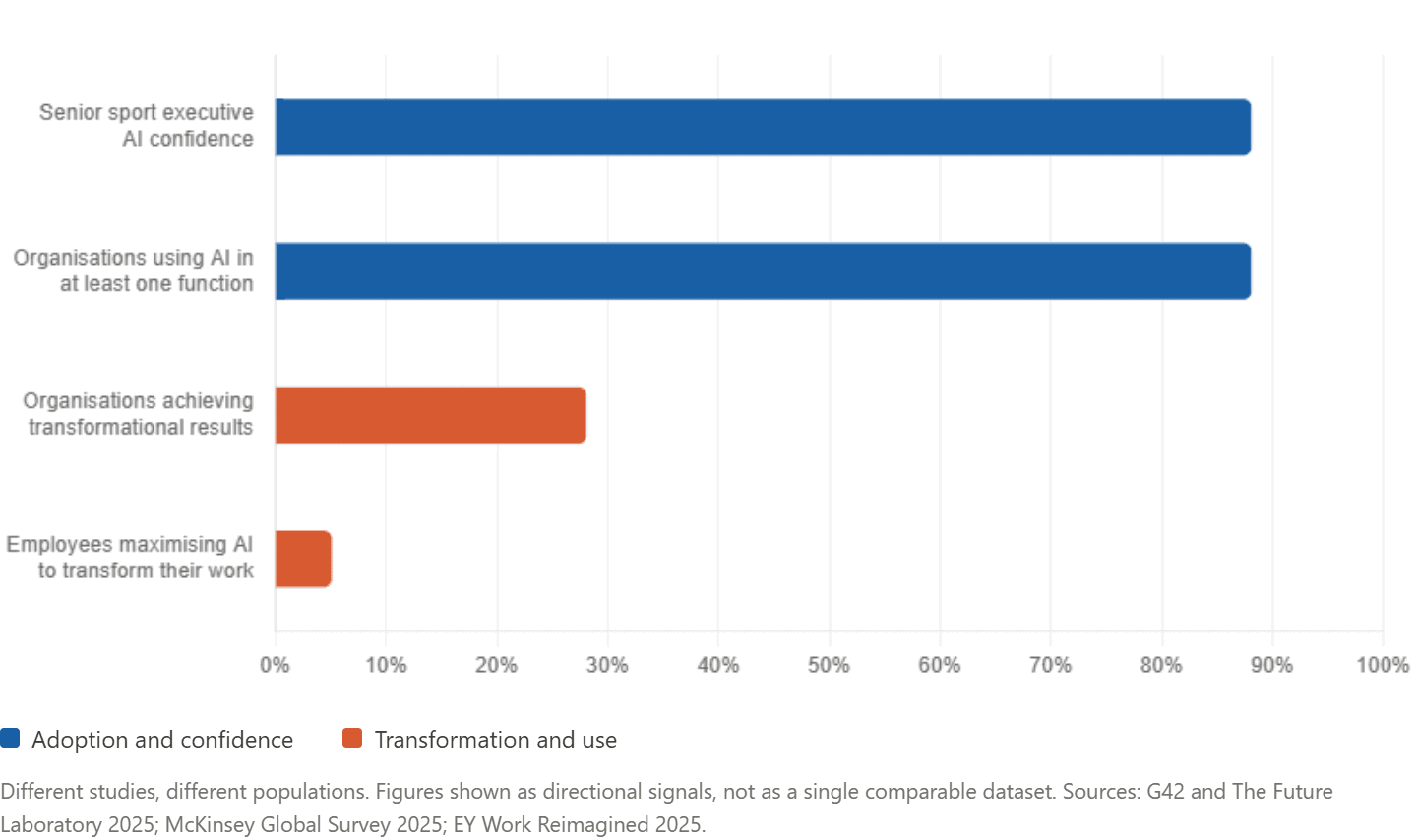
Recent studies across different populations converge on the same pattern. G42 and The Future Laboratory found that 88% of surveyed senior sport executives expressed confidence in AI adoption. McKinsey's 2025 Global Survey found that 88% of organisations use AI in at least one business function. Yet EY's 2025 Work Reimagined research found that only 5% of employees report maximising AI to transform their work, and only 28% of organisations achieve transformational results.
These figures come from different studies of different groups, so they cannot be directly compared. But the underlying signal is consistent across all of them: tools are being deployed faster than people are being trained to use them. In sport, this appears as the difference between "we have AI" and "our people can interpret what it tells us."
The consequence is not theoretical. Organisations that procure without preparing create dependency on vendor narratives. Staff absorb tools they were never trained for. And the gap between deployment and capability quietly widens.
The tools are arriving. Training can turn adoption into capability.
Signal 2: AI Use in Coaching Is Already Emerging Informally
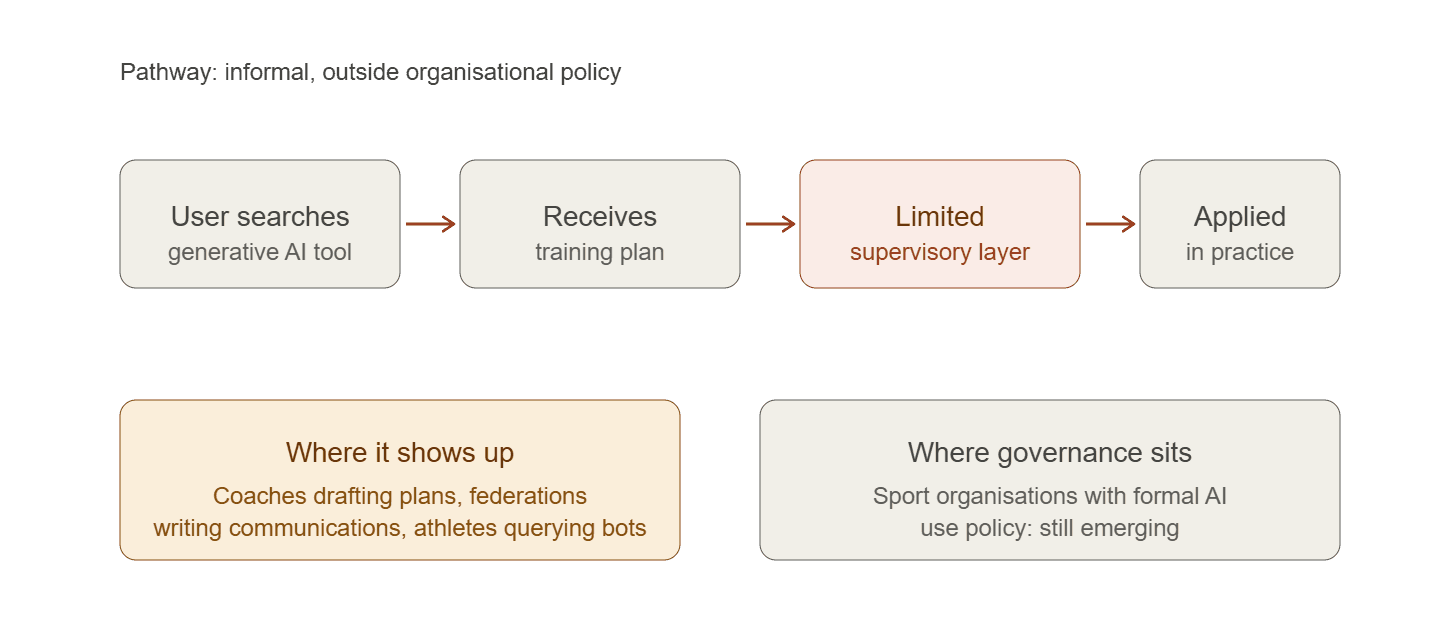
A 2025 pilot study from researchers at the University of Innsbruck (Wachholz et al., BMC Research Notes) examined how recreational athletes and experienced coaches engage with AI-generated training plans. The study documented that AI tools, including ChatGPT, are already being used for informal training plan generation, with limited integration into organisational practice or supervisory structures.
Adjacent research across sectors reinforces the pattern. A 2025 WalkMe and IDC survey on enterprise AI adoption found that informal AI use is widespread, training gaps consistently undermine return on investment, and organisations buying licences without preparing their staff are seeing limited measurable benefit.
In sport, the implications are sharper. Training decisions informed by AI-generated plans the user has not been trained to evaluate, federation staff drafting communications with generative tools, athletes consulting public chatbots for nutritional or training advice: these patterns are present across European sport, and the governance layer around them is still being built.
AI use in coaching is already emerging. Guidance can make it responsible.
Signal 3: Article 4 of the AI Act Is in Force; the Sector Response Is Still Forming
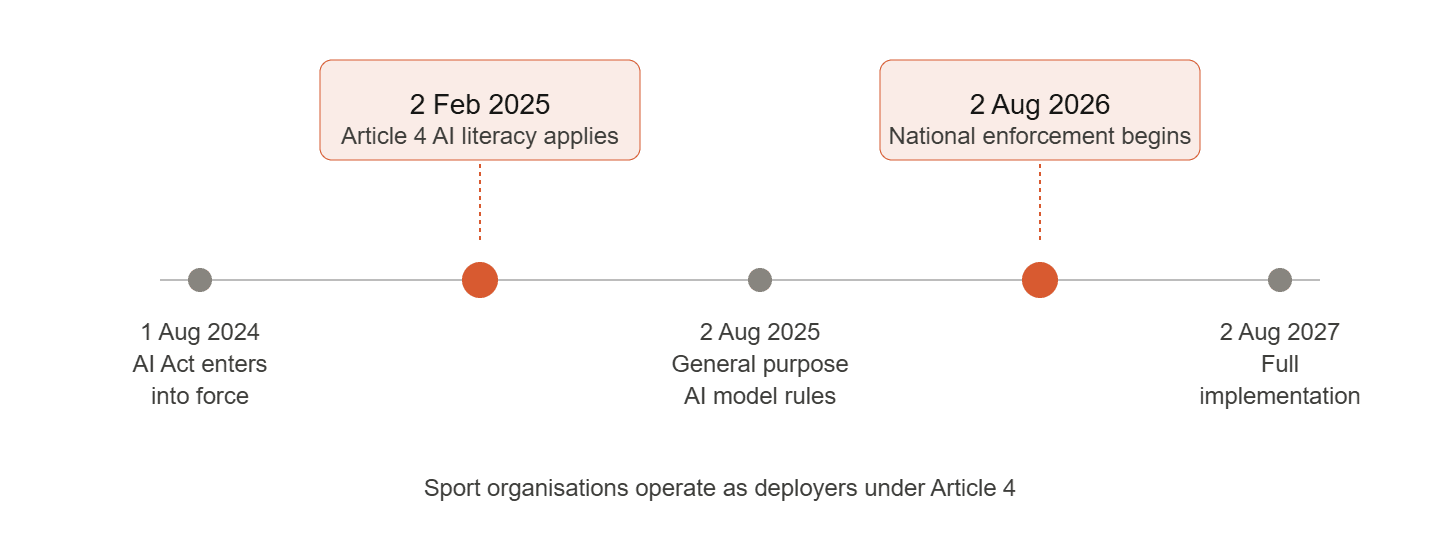
On 2 February 2025, Article 4 of the EU AI Act became applicable. Any provider or deployer of an AI system must ensure that staff and other persons operating the system have a sufficient level of AI literacy, taking into account their role, the context in which they work and the nature of the AI system. From 2 August 2026, national market surveillance authorities begin supervising and enforcing this obligation.
This applies to sport organisations using AI in any of its forms: video analysis platforms, talent identification tools, performance dashboards, biometric monitoring systems, fan engagement applications and AI-generated content. The obligation is not theoretical. It is in force now.
A sport sector-specific AI literacy guidance, aligned to Article 4 and adapted to the realities of coach education, federation governance and grassroots delivery, has not yet emerged. The compliance horizon is approaching faster than the sector's collective response is forming.
Article 4 creates a clear readiness window for sport before August 2026.
Signal 4: The AILit Framework Opens a Window for Sport to Engage
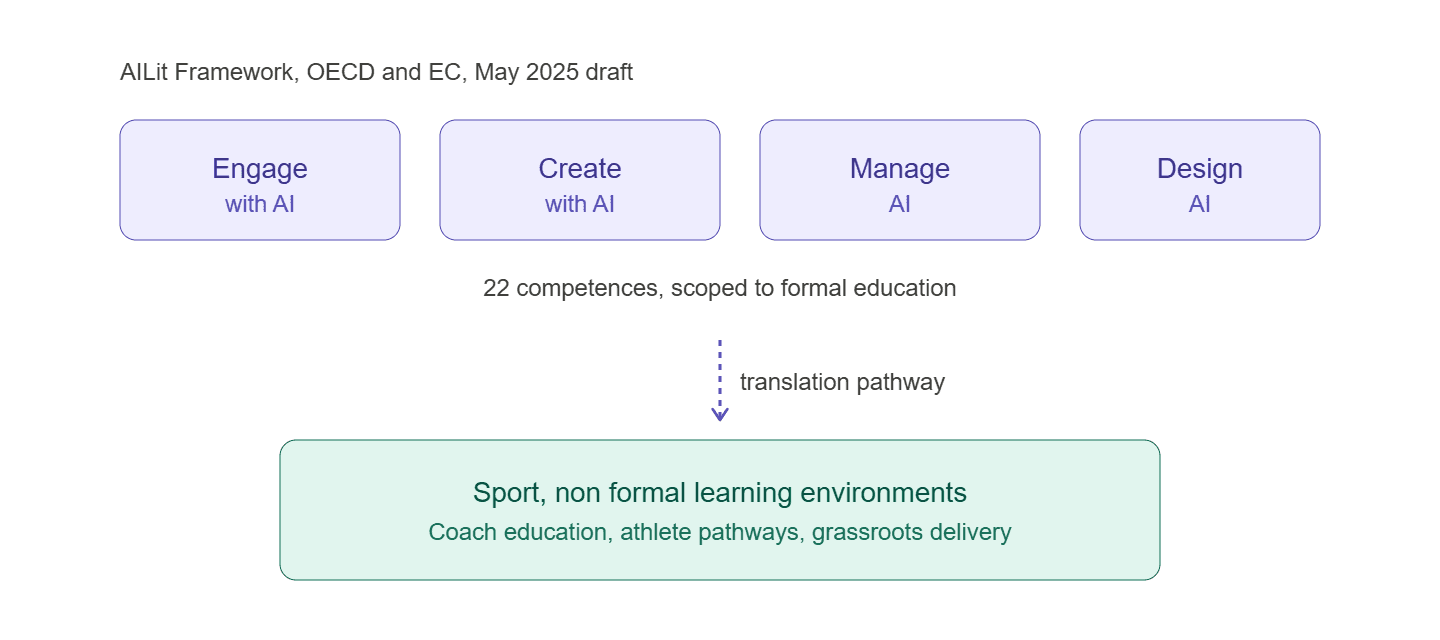
In May 2025, the OECD and the European Commission, with Code.org, released the draft AILit Framework: Empowering Learners for the Age of AI. The framework defines 22 competences across four domains: engage with AI, create with AI, manage AI and design AI. A global stakeholder consultation followed, involving more than 1,200 participants in over 50 events and 800+ survey respondents from 97 countries. The framework will inform the PISA 2029 Media and AI Literacy assessment.
The AILit Framework is appropriately scoped to formal primary and secondary education. The translation of its competences into non-formal learning environments, the spaces where sport reaches tens of millions of children and adults weekly through clubs, federations and grassroots organisations, has not yet been systematically mapped.
This is not an oversight by the framework's authors. It is an open space that the sport ecosystem can collectively fill. As AILit moves through its next development phase, sport has a window to engage, contributing perspectives from coach education, athlete pathways and grassroots delivery. Working alongside the framework positions European sport to align with the next decade of EU AI literacy policy rather than catch up with it.
The window is open. The question is whether sport steps through it.
Signal 5: Procurement Is Outpacing Governance Capacity Across Sport
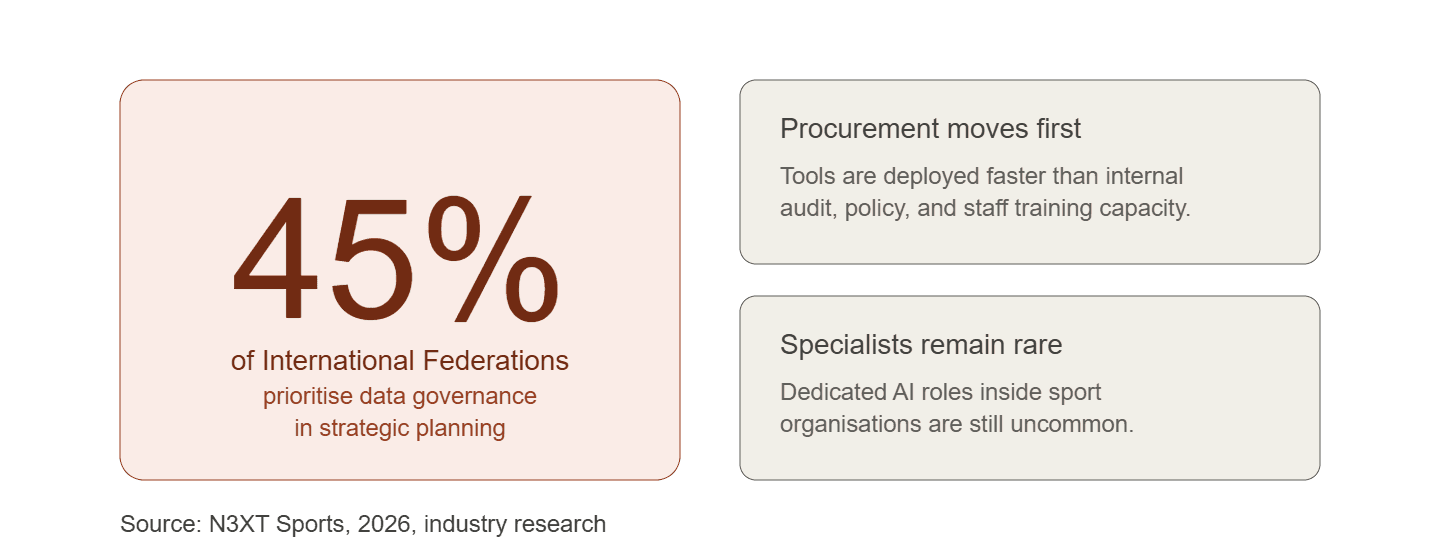
Recent N3XT Sports research indicates that only 45% of International Federations prioritise data governance in strategic planning, even as sport organisations move deeper into data sharing, AI-powered athlete and fan intelligence, and digital transformation programmes. The gap between "we are transforming digitally" and "we govern our data responsibly" is 36 percentage points.
Dedicated AI specialist roles inside sport organisations remain rare. Procurement happens; governance follows more slowly; and the existing staff inside organisations are often expected to absorb tools they were not trained for. This is a structural pattern, not a failure of any single organisation.
Closing the procurement-to-governance gap is one of the central challenges this scan identifies. It is also one where sector-wide collaboration, shared templates, common frameworks, coordinated training, would create substantially more value than organisation-by-organisation effort.
Sport can pair AI adoption with the governance capacity to use it well.
Trend 1: AI Literacy Becomes the Skills Foundation of European Sport
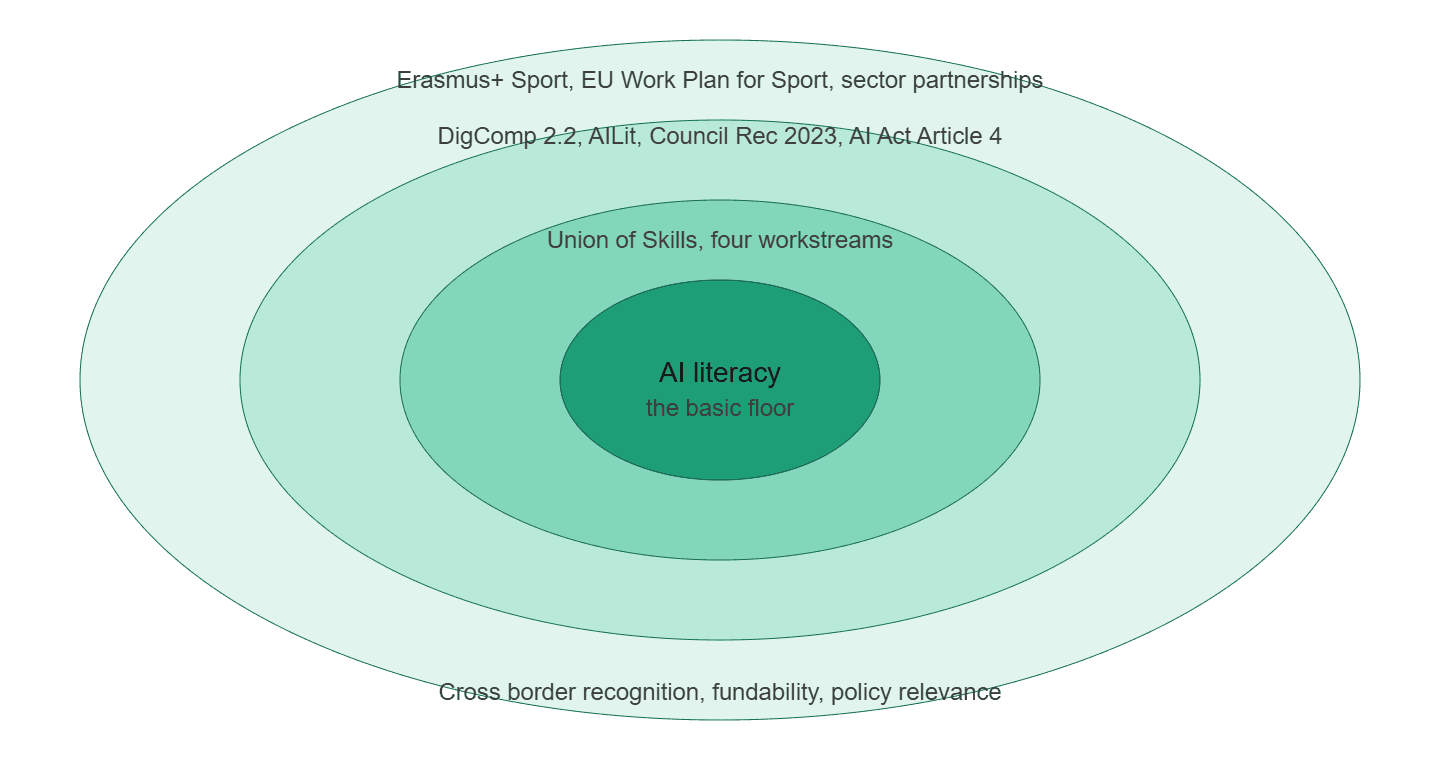
The Union of Skills, launched in March 2025, sets four workstreams: building skills for life, upskilling and reskilling, circulating skills across the single market and attracting talent. AI literacy sits across all four. The European Commission has explicitly named AI literacy as a foundation for the wider digital and competitiveness agenda.
For sport organisations, this trend means AI literacy is becoming part of the basic floor rather than an optional add-on. Federations that align their internal training, coach development and volunteer education with European competency frameworks, including DigComp 2.2, the Council Recommendations of November 2023 and the AILit Framework as it develops, will be better positioned for Erasmus+ funding, EU policy dialogue and cross-border skills recognition.
Organisations with limited alignment may face friction in demonstrating the portability, fundability and policy relevance of their training programmes. As the Union of Skills shapes the next EU programming period, sport's structural distance from these frameworks will either narrow or widen depending on choices made now.
For European sport, AI literacy is no longer an aspiration. It is becoming a baseline.
Trend 2: The Coach Becomes a Human in the Loop
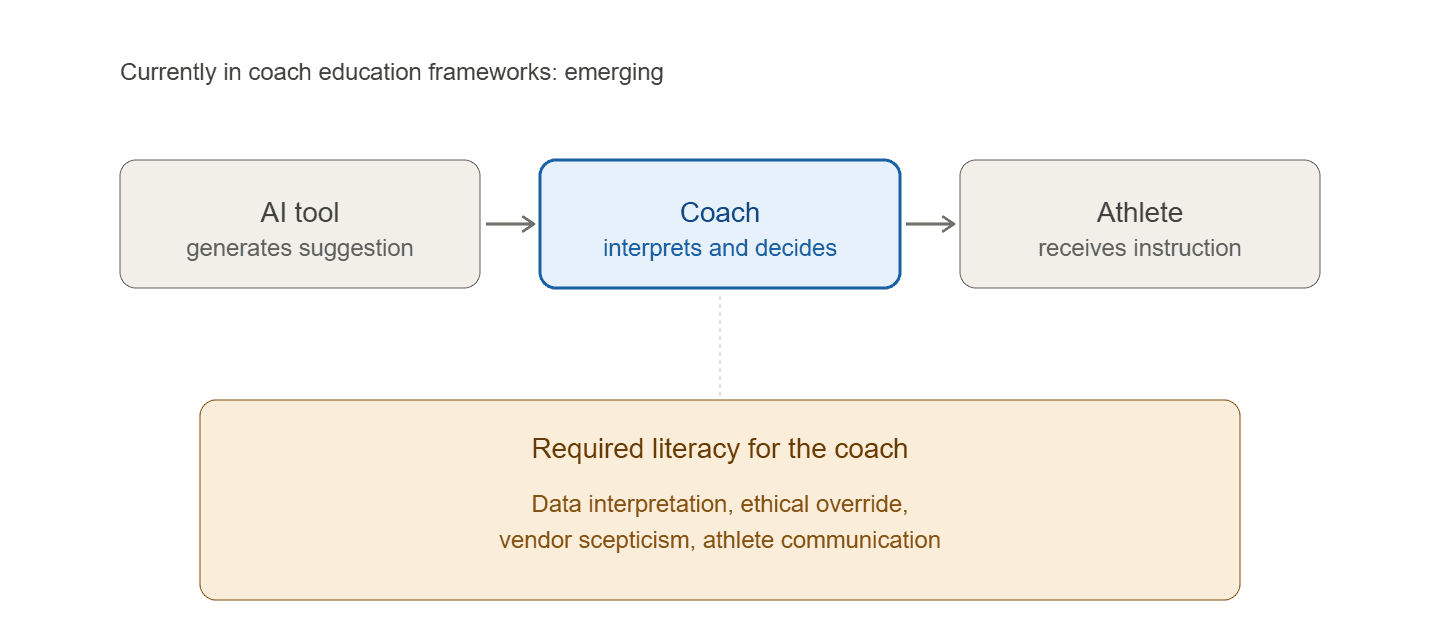
A 2025 systematic review of AI in digital sports coaching (Managing Sport and Leisure) analysed 40 papers and identified the core functions AI is now performing alongside coaches: technique analysis, load management, opponent modelling and training plan generation. A parallel 2025 study (Frontiers, O'Brien and Prentice) examined how coaches engage with freely available generative tools as part of their continuing learning, often without their organisation's knowledge.
The trend is the coach moving from sole decision-maker to "human in the loop" between AI tools and athletes. This shift requires a literacy that the International Sport Coaching Framework, whose most recent core update predates the wearable and AI era, does not yet fully address. National coach education pathways are at varying stages of integrating AI literacy modules. The gap is structural, not individual.
A meaningful share of European coaches active in 2030 will be working alongside AI in their day-to-day practice. Whether that work is supported by training, policy and ethical frameworks, or shaped informally by individual experimentation, depends on the choices the sector makes before those coaches arrive in that moment.
By 2030, many European coaches will work as humans in the loop. Training can help them use AI with confidence.
Trend 3: Volunteers Become the Frontline of AI Compliance
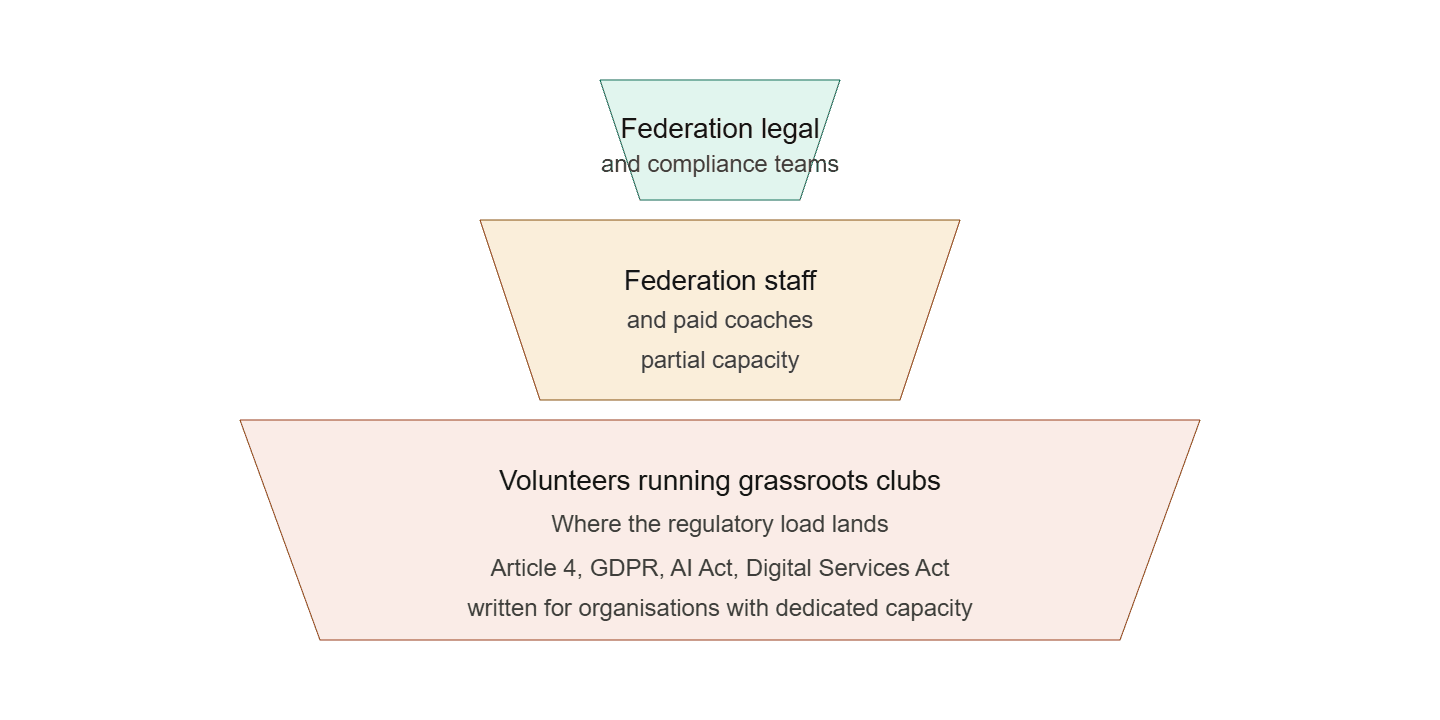
European grassroots sport runs on volunteers, with estimates placing the number of unpaid grassroots volunteers across Europe in the millions. These are the people running club registrations, processing children's data, deciding which apps the club uses, sharing training footage on social media and, increasingly, evaluating AI tools that promise to make their work easier.
Article 4 of the AI Act may become relevant where volunteers use AI systems on behalf of a sport organisation, particularly where the organisation acts as a deployer. GDPR applies to the personal data they handle. The Digital Services Act shapes the platform environment through which clubs communicate. The compliance expectations across these frameworks, designed for organisations with dedicated legal and technical capacity, can land on people whose primary qualification is willingness.
The previous SF4Sport report, Who's Watching the Kids? AI in Grassroots Sport, showed that a substantial share of grassroots clubs operate without a documented data protection policy, and that volunteers often handle club data on personal devices. Adding AI literacy obligations to this baseline without sector-level support is unlikely to produce reliable compliance. Sector-wide infrastructure, simplified guidance and shared tooling would reduce the burden on individual volunteers while raising the floor across the whole ecosystem.
Volunteers are the backbone of European grassroots sport. They should not have to navigate AI compliance alone.
The Gap: AI Literacy Standards Exist Across Sectors; the Sport Translation Is Still Forming
This is one of the clearest findings of the entire analysis.
DigComp 2.2 includes more than 250 examples of how AI literacy fits within general digital competence. The AILit Framework defines 22 competences for primary and secondary education. UNESCO's AI competency frameworks set global benchmarks. The Council of the European Union's 2023 Recommendations on digital education and skills give member states clear direction. The European Digital Innovation Hubs offer AI training to small and medium enterprises across Europe.
On one side: DigComp 2.2, the AILit Framework, UNESCO AI competency standards, Council Recommendations 2023, AI Act Article 4 obligations. On the other side: sport organisations with limited AI governance, no sector-specific AI literacy certification with wide recognition, and a coach education framework that predates the AI era.
The frameworks for AI literacy exist. The translation into sport contexts, into coach education curricula, into volunteer training, into federation governance, into athlete development pathways, has not yet systematically happened. Sport is adopting the technology faster than it is adapting the standards to its own settings.
The standards are there. The translation is the work ahead.
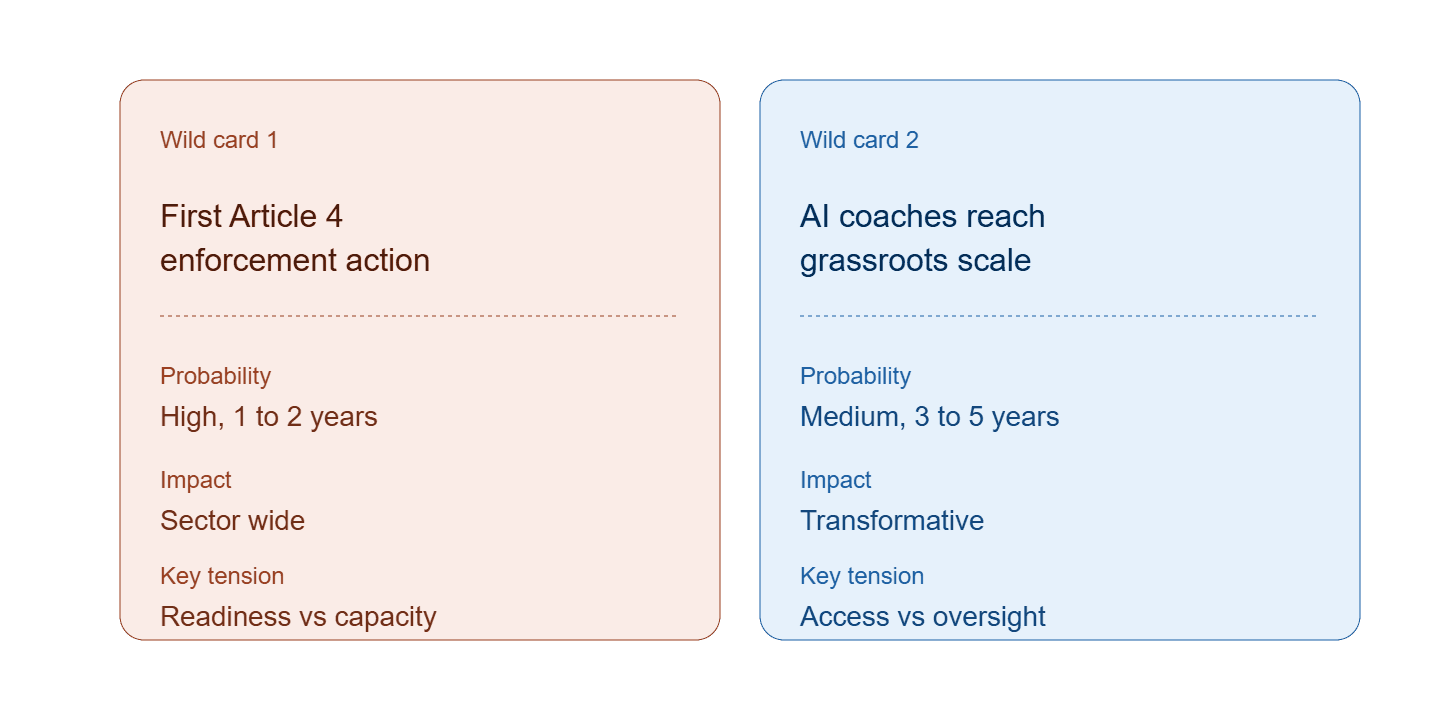
Wild Card 1: What If the First Article 4 Enforcement Action Sets the Tone?
A wild card is a low-probability, high-impact event that could shift the entire landscape quickly.
From 2 August 2026, national market surveillance authorities across the EU begin supervising compliance with Article 4 of the AI Act. The first AI literacy enforcement action in any sector, regardless of where it lands, will set the regulatory tone for all deployer contexts. Once a precedent exists, organisations move from "we will get to it" to "we have to be ready now."
For sport, the implication is not that the sector is uniquely exposed. It is that the regulatory landscape will sharpen quickly once enforcement begins, and the sector's collective preparedness benefits from being established before, rather than after, that moment.
The probability is high within a 1 to 2 year window. The impact, if realised, would be sector-wide acceleration. The key tension is between compliance readiness and current capacity. Organisations that have already built AI literacy training, governance frameworks and staff onboarding procedures will be protected. Those that have not will face reputational and operational exposure precisely when the spotlight is brightest.
The question is not whether Article 4 will be enforced. It is whether sport will be ready when it is.
Wild Card 2: What If AI Coaches Reach Mass Adoption at the Grassroots?
By 2030, generative AI tools combined with wearable data and video analysis could produce a "coach in your pocket" experience: personalised training plans, real-time technique feedback, load management advice and motivational support. For families priced out of paid human coaching, AI coaches could become the only accessible alternative.
The Aspen Institute's Project Play 2025 survey found that average US family spending on a child's primary sport reached USD 1,016 in 2024, a 46% increase over 2019 and roughly twice the rate of general inflation. The figure is US-specific, but the affordability pressure it reflects is recognised across many European countries.
The trade-off carries both promise and risk. On one side: cheaper access, lower barriers to entry, broader participation. On the other: reduced human oversight, weaker safeguarding pathways, less transmission of sport's social and ethical dimensions, and an AI literacy gap that compounds at the family level before any institutional response reaches them.
The probability is medium within a 3 to 5 year window. The impact would be transformative. The key tension is between access and oversight. Wild Card 2 is a market shock rather than a regulatory shock, and market shocks often move faster than regulatory ones.
The AI coach product could reach mass adoption before the literacy framework reaches the families using it.
So What Now?
The signals and trends in this analysis make one thing clear: closing the AI literacy gap in European sport is becoming a shared priority. Article 4 of the AI Act establishes the legal floor. The Union of Skills sets the strategic direction. The trust between sport and the millions of coaches, volunteers, administrators and athletes inside it depends on the ethical layer.
Three priority areas emerge from the analysis. They are not prescriptions; they are observations of where collective work is most likely to create sector-wide value.
Priority 1: Sport-Specific AI Literacy Curriculum
Adapting DigComp 2.2 and the AILit Framework into a sport sector curriculum covering coaches, volunteers, administrators and athlete development pathways. The SHARE 2.0 Community of Practice on Innovation has named a related theme as its primary focus for February to August 2026, with AI literacy and education as the leading workstream. Sector-level coordination is becoming possible.
This aligns with the EU AI Act's Article 4 literacy obligations, the Digital Education Action Plan 2021 to 2027, the Union of Skills' upskilling workstream and Erasmus+ Sport's horizontal priority on Digital Transformation.
Priority 2: Federation-Level AI Policy Templates
Equipping federations with reusable AI deployment policies, vendor evaluation checklists and Article 4 alignment pathways. Without shared templates, every federation reinvents the same wheel independently. With them, the sector moves together and smaller organisations benefit from the governance work done by larger ones.
This aligns with the EU AI Act's deployer obligations, the Union of Skills' single market workstream and the EU Work Plan for Sport 2024 to 2027's digital innovation priority.
Priority 3: Volunteer Support Infrastructure
Volunteers cannot reasonably carry the AI compliance burden alone. National federations and umbrella bodies can provide simplified guidance, lightweight training and shared digital tools that meet the legal expectations without overwhelming the people running grassroots sport. The EU AI Act's literacy obligations, the GDPR requirements for data handlers and the Digital Services Act's platform rules all apply to the volunteer layer. Supporting that layer is both a legal and an ethical imperative.
This aligns with GDPR Articles 5, 24 and 25, the AI Act's Article 4 literacy requirements, Erasmus+ 2026 capacity-building instruments and the EU Work Plan for Sport 2024 to 2027's grassroots integrity priorities.
EU Policy Alignment
Our analysis found strong alignment between the findings in this report and six active EU policy frameworks. The strongest connections run through the EU AI Act (Regulation 2024/1689, Article 4 literacy obligations and deployer requirements), the Union of Skills (March 2025, all four workstreams), DigComp 2.2 (250+ AI literacy competence examples), the AILit Framework (OECD and European Commission, May 2025 draft, 22 competences), the Digital Education Action Plan 2021 to 2027 (Council Recommendations of November 2023), and Erasmus+ Sport 2026 (Digital Transformation and Inclusion horizontal priorities).
The convergence of these frameworks in the 2025 to 2027 window creates a unique opportunity for sport to engage collectively, rather than responding individually when compliance deadlines arrive.
This article is part of the SF4Sport Strategic Foresight Series by Sport Singularity. The analysis draws on peer-reviewed academic research and maps EU policy frameworks including the EU AI Act, Union of Skills, DigComp 2.2, the AILit Framework, Erasmus+ 2026 and the EU Work Plan for Sport 2024 to 2027. This report is a strategic foresight and environmental scanning output. It is not legal advice.
May 2026, Sport Singularity, SF4Sport