Who Holds the Forecast? The Ocean Is Now a Condition of Sport
Author: G.Aydin, H.Ege

This is a Sport Singularity strategic foresight report: it reads the signals already shaping European sport, sets out the plausible futures they point to, and turns them into practical choices for clubs, federations and public bodies.
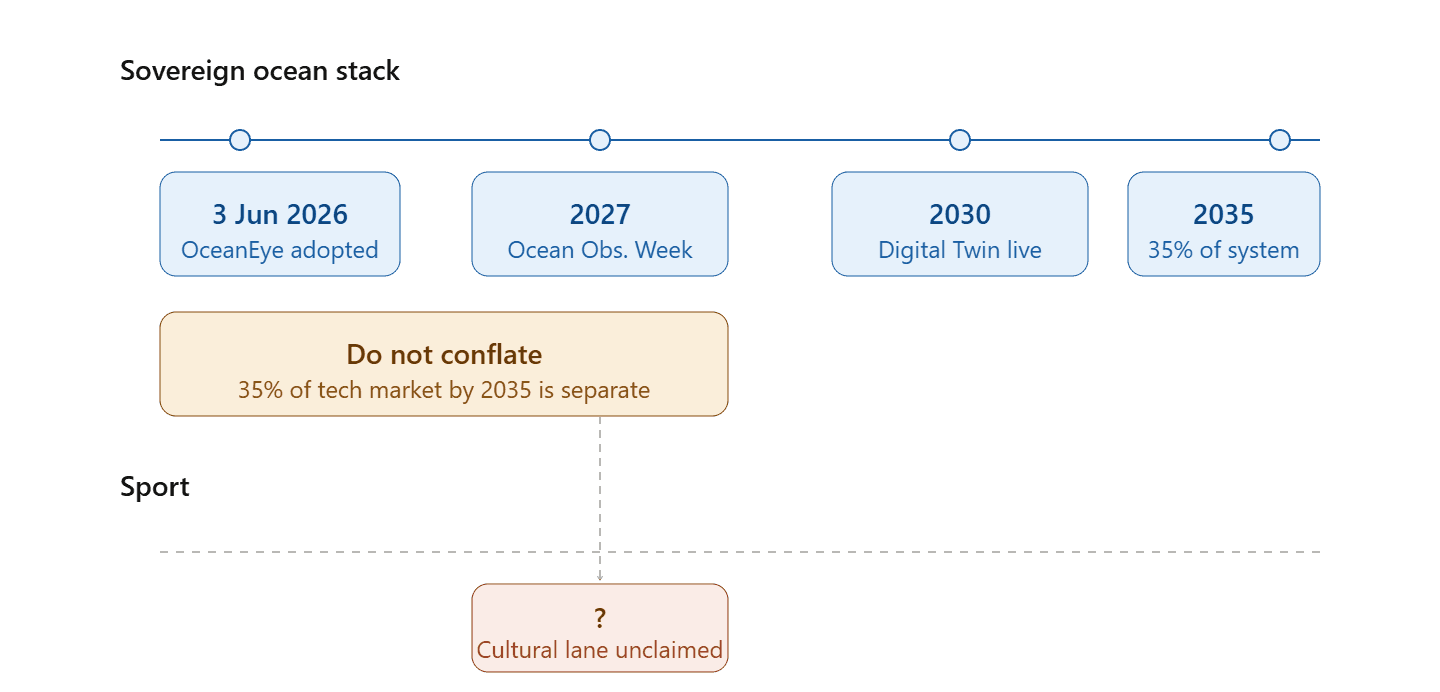
On 3 June 2026 the European Commission adopted OceanEye, its flagship ocean-observation initiative, with the stated ambition of making the EU the world's leading provider of ocean intelligence. Six weeks earlier, in the summer the world watched the year before, the Paris 2024 men's Olympic triathlon had been postponed at dawn, not by wind, wave, current, or heat, but by faecal bacteria in the Seine. These two facts sit on either side of a gap. A sovereign, free, public intelligence layer for the ocean is being stood up on a published timeline. The variable that actually decides whether an aquatic event can run is not the variable that layer forecasts. And on the evidence this scan could find, no one has built the bridge between them. This report is about that space.
Signal 1: OceanEye Arrives 3 June 2026, and Sport Is Not in the Room
A funded, sovereign ocean-intelligence layer is being built on a published timeline; in this scan, its cultural-engagement lane is almost entirely unclaimed by sport.
On 3 June 2026 the European Commission adopted OceanEye. The headline targets confirmed against primary sources are precise: the EU aims to provide 35% of the global ocean observing system by 2035 and to deliver a fully operational European Digital Twin Ocean by 2030, offered as a free public service. The package rests on four pillars, unified data governance, a new international alliance for the Global Ocean Observing System, the Digital Twin and innovation markets, and public engagement, and carries roughly €92m, of which €62m is the Horizon Europe contribution to global data systems and around €30m supports observation-technology innovation.
One disambiguation this scan flags for downstream readers: OceanEye carries a second, distinct 35% target, capturing 35% of the global market for ocean-observation technologies by 2035, easily conflated with the 35% of the global observing system figure above. These are not the same number.
What the scan identifies as the unclaimed ground is OceanEye's cultural and educational lane: public installations, museum exhibitions, a New European Bauhaus Lab turning ocean data into art, an Ocean Observation Week in 2027, and school engagement through EU4Ocean. This lane is real, funded, and, in this scan, almost entirely unclaimed by sport. We did not identify a sporting body, federation, or athlete-led coalition positioned within it.
The deeper observation is one of adjacency, not connection. The same sovereign intelligence stack being built for climate and biodiversity policy is, by quiet adjacency, the prospective governing layer for aquatic sport, where events can safely be held, for whom, and when. This scan does not find that connection being made by anyone, and it is the absence, not a stated EU intention, that is the finding here. We found no institutional bridge between OceanEye and aquatic-sport governance, and this signal should be read as the open edge of that gap rather than evidence that the bridge is planned.
Signal 2: Pathogens, Not Physics, Postponed the Paris 2024 Triathlon
The Paris 2024 men's triathlon was postponed once the Seine breached World Triathlon's E. coli threshold; the deciding variable is precisely what the sovereign ocean stack does not forecast.
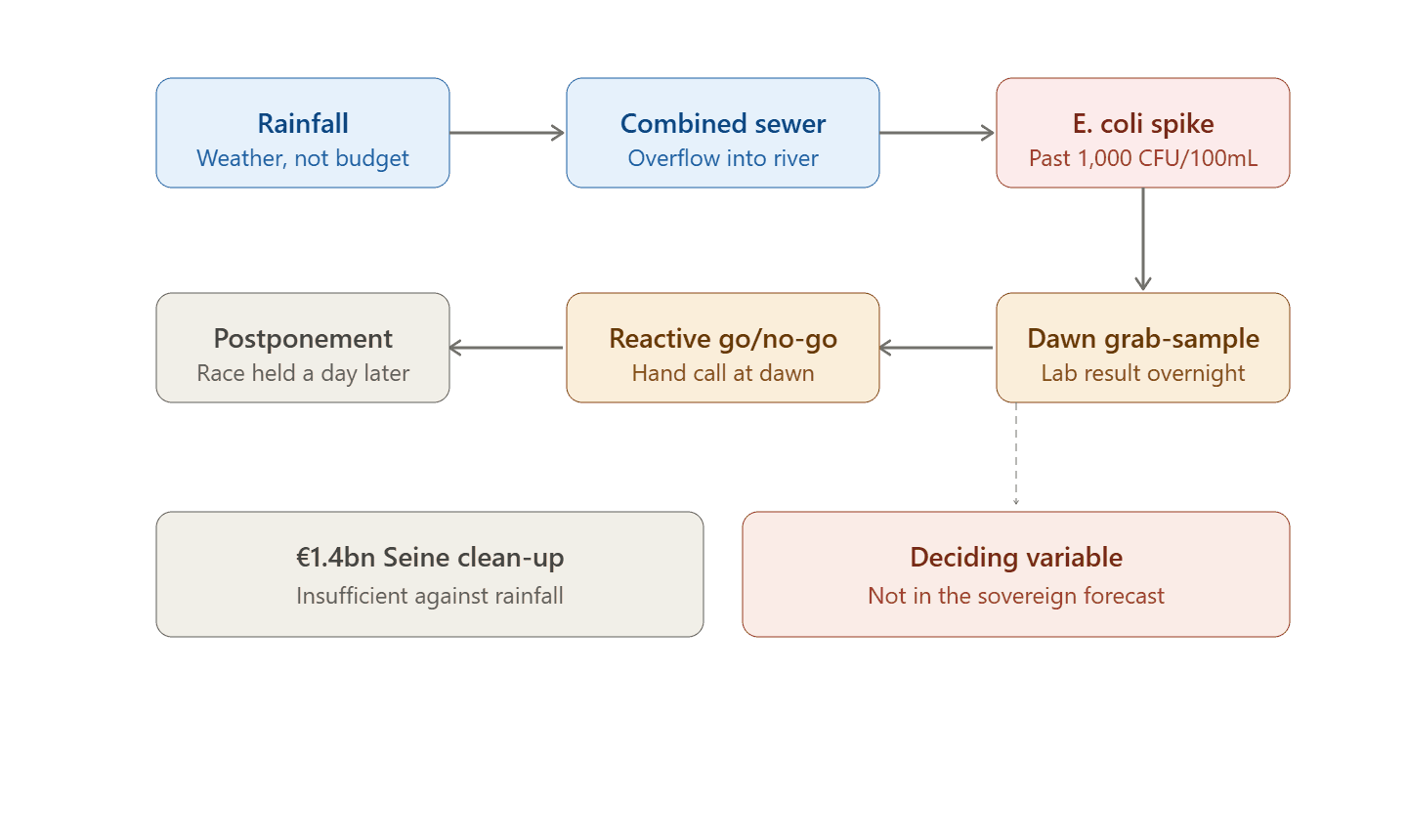
The Paris 2024 men's triathlon was postponed, and training swims cancelled, after the Seine exceeded World Triathlon's E. coli go/no-go threshold of 1,000 CFU/100mL following rainfall. One of four testing sites returned readings of 980 to 1,553 CFU/100mL, straddling and exceeding the limit.
This was not a budget failure. Paris spent roughly €1.4bn (about US$1.5bn) improving the Seine ahead of the Games, and bacteria still fluctuated with rainfall, because the hazard tracks weather, not capital expenditure.
The deciding mechanism was reactive, not predictive. Go/no-go calls were made via daily lab grab-samples judged against fixed thresholds in dawn coordination meetings; a marathon-swim training session was cancelled after one such early-morning meeting, and the men's race was postponed. A sample is drawn, sent to a lab, returned, and judged against a line in the rulebook, a snapshot of yesterday's water used to decide today's race.
This scan flags the structural mismatch directly. The deciding variable, faecal pathogens driven by rainfall and combined-sewer overflow, is exactly what the sovereign ocean stack does not forecast. As captured in Signal 1, the European Digital Twin Ocean and Destination Earth's extremes twin forecast physics and biogeochemistry: currents, waves, tides, chlorophyll, coastal flooding. What decided Paris 2024 sits outside that stack. The pathogen-predictive capability that did inform the event was bespoke, the Fluidion Seine models built for that single elite venue, not the public sovereign layer.
Scope discipline: this is one event in one river. This scan does not support the generalisation that every aquatic venue behaves like the Seine, nor that grab-sampling failed; within its design it worked, and the men's race was held a day later. The narrower finding is sharper: the decision standard for elite aquatic sport remains reactive and threshold-based, and the variable it turns on is not in the sovereign forecast.
Signal 3: Heat Has Already Rewritten the Rulebook
A 2023 World Athletics survey of 373 athletes found 85% saying their sport had experienced adverse consequences from climate change and 75% perceiving a direct impact on their own health; governing bodies have responded with thresholds, not statements.
The physiological case that heat has become a condition of sport is the best-established part of this scan's evidence base. The headline figures come from a 2023 World Athletics survey of 373 athletes: 85% said the sport had experienced adverse consequences from climate change, and 75% perceived a direct impact on their own health and performance. A note for precision, because this scan repeatedly found the wrong number in circulation: the often-cited 77% is not the harm figure, it refers only to athletes describing themselves as extremely or very concerned about the climate crisis. This scan uses 85%/75% and treats the 77% framing as inaccurate.
The collapses are not abstractions. At the Tokyo 2020 Olympics (held 2021), triathlon gold medallist Kristian Blummenfelt collapsed at the finish, tennis player Paula Badosa retired with heatstroke in a wheelchair, and archer Svetlana Gomboeva collapsed from heat exhaustion. The Olympic marathon had already been relocated around 800km north to Sapporo over heat concerns, reinforced by the Doha 2019 World Championships, where 28 of 68 women and 18 of 73 men failed to finish the marathons in extreme heat and humidity. At the 2023 US Open, Daniil Medvedev took two medical timeouts and used an inhaler in around 35°C heat.
The governance response is what distinguishes heat from the other hazards in this scan: it has hardened into rules. Governing bodies have adopted Wet Bulb Globe Temperature (WBGT) thresholds across tennis, athletics, open-water swimming and football, and the ATP will align with the WTA heat policy, both built on the WBGT index, from the 2026 season. This scan reads the relocated Olympic marathon, the WBGT thresholds, and the 2026 ATP to WTA alignment as evidence that for heat, schedule, venue and stoppage are already gated by an environmental index: the rulebook has been rewritten, not merely debated.
Two scope notes. First, this scan does not support generalising the 85%/75% figures beyond the surveyed population: they are athlete-reported perceptions from a single 373-athlete survey, not a measured cross-sport outcome. Second, the named collapses and DNF counts are discrete elite-event incidents; they evidence that heat already decides outcomes at the top tier, but the broader distributional burden, who bears heat risk when adaptation capacity is unequal, is a separate finding (see Signal 5).
Signal 4: UK Grassroots Sport's £320m Weather Bill Falls Hardest on Those Least Able to Pay
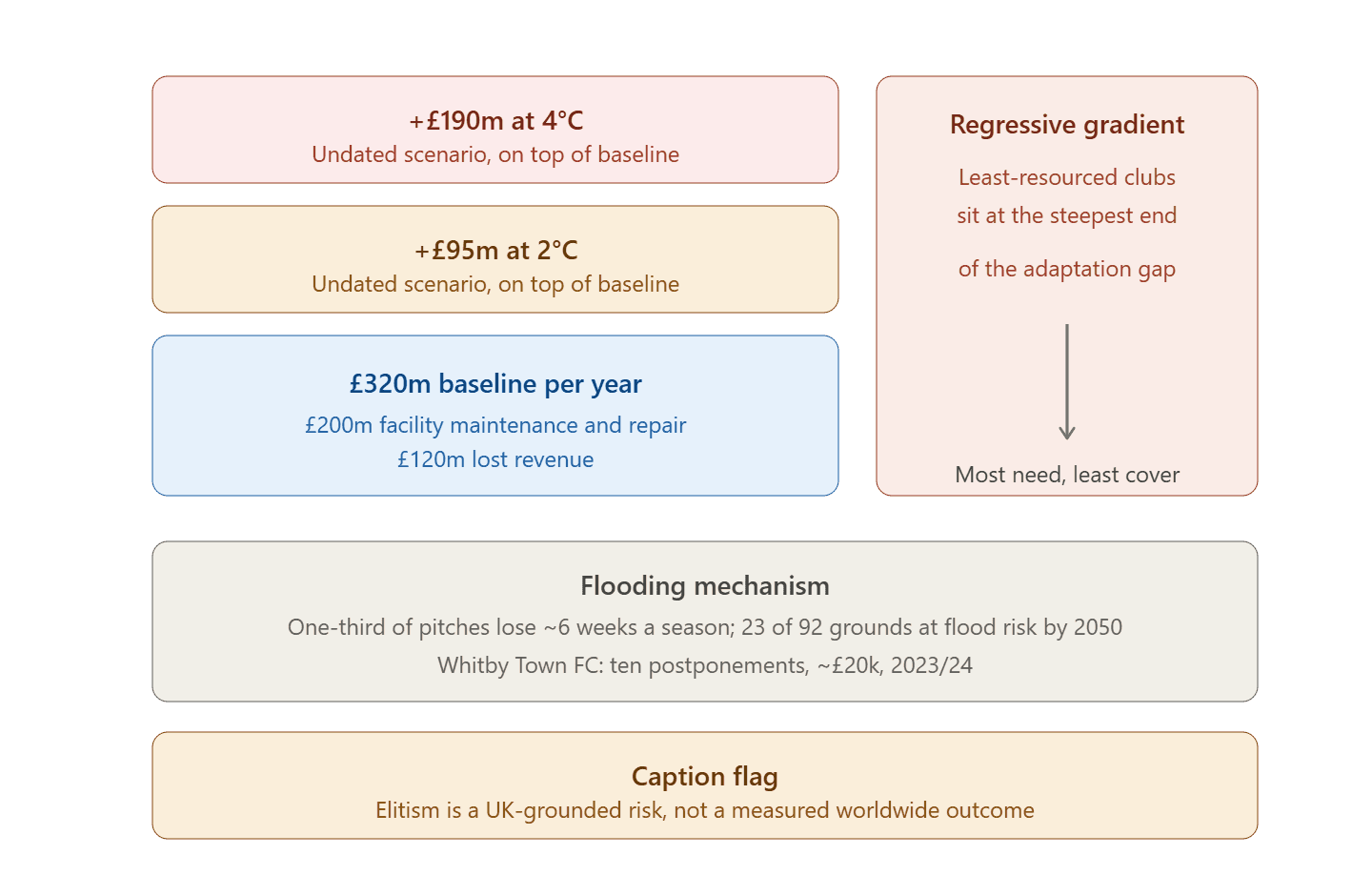
A DCMS-commissioned study puts the annual weather bill at £320m; the becoming-elitist finding is a UK-grounded, globally-extrapolated risk, not a measured worldwide outcome.
A DCMS-commissioned study (Alma Economics, September 2025) estimates that adverse and extreme weather costs UK grassroots sport £320m per year, roughly £200m in facility maintenance and repair and £120m in lost revenue from cancellations and forced closures. Separately, around 120,000 grassroots football matches are cancelled each year in England due to bad weather, a football-specific number the study cites from secondary sources, not a count across all grassroots sport, and it should not be generalised as such. The same modelling projects the annual impact rising by an additional £95m at 2°C of warming and £190m at 4°C, on top of the £320m baseline; the source attaches no date to when those warming levels are reached, so these are conditional scenario figures, not dated forecasts.
The regressive shape of the burden is what makes this a spine finding rather than a line item. The accompanying Reading University/BASIS research warns that grassroots sport risks becoming elitist because lower-resourced clubs cannot afford to protect their grounds, leaving under-served communities denied the wider health and economic benefits of sport. The government report itself notes that low socio-economic groups, older people, children and disabled people are the most impacted. This scan does not support generalising the elitism thesis into a measured worldwide outcome: it is a single national research line, credible and quotable, but one country and one study cluster, with the global generalisation asserted as reasoned inference rather than separately evidenced.
The physical mechanism is flooding and drainage failure. Around one-third of England's grassroots pitches already lose roughly six weeks a season to flooding and inadequate drainage; 23 of the 92 EFL/Premier League grounds are projected to face partial or total annual flooding by 2050; and Whitby Town FC had ten home games postponed for waterlogged pitches in 2023/24, with estimated losses of around £20,000. The pattern is structurally regressive: the clubs least able to pay for drainage, covers, and ground protection are the ones serving the communities that most depend on accessible sport.
One honest gap belongs here, because it is itself a finding. Robust economic figures exist at the aggregate UK grassroots level, but this scan found no quantified cost estimates isolating the climate burden on the lowest-income cohorts at this tier, and (carried into Signal 5) none isolating para-athletes specifically. The elitism thesis should therefore travel as a well-sourced risk, not a fully quantified worldwide outcome.
Signal 5: Adaptation Capacity Runs Inverse to Need, Para-Athletes at the Sharp End
The bodies least equipped to absorb heat and polluted water are the least likely to have anyone on site who can intervene; this scan found no quantified cost estimate isolating that burden at all.
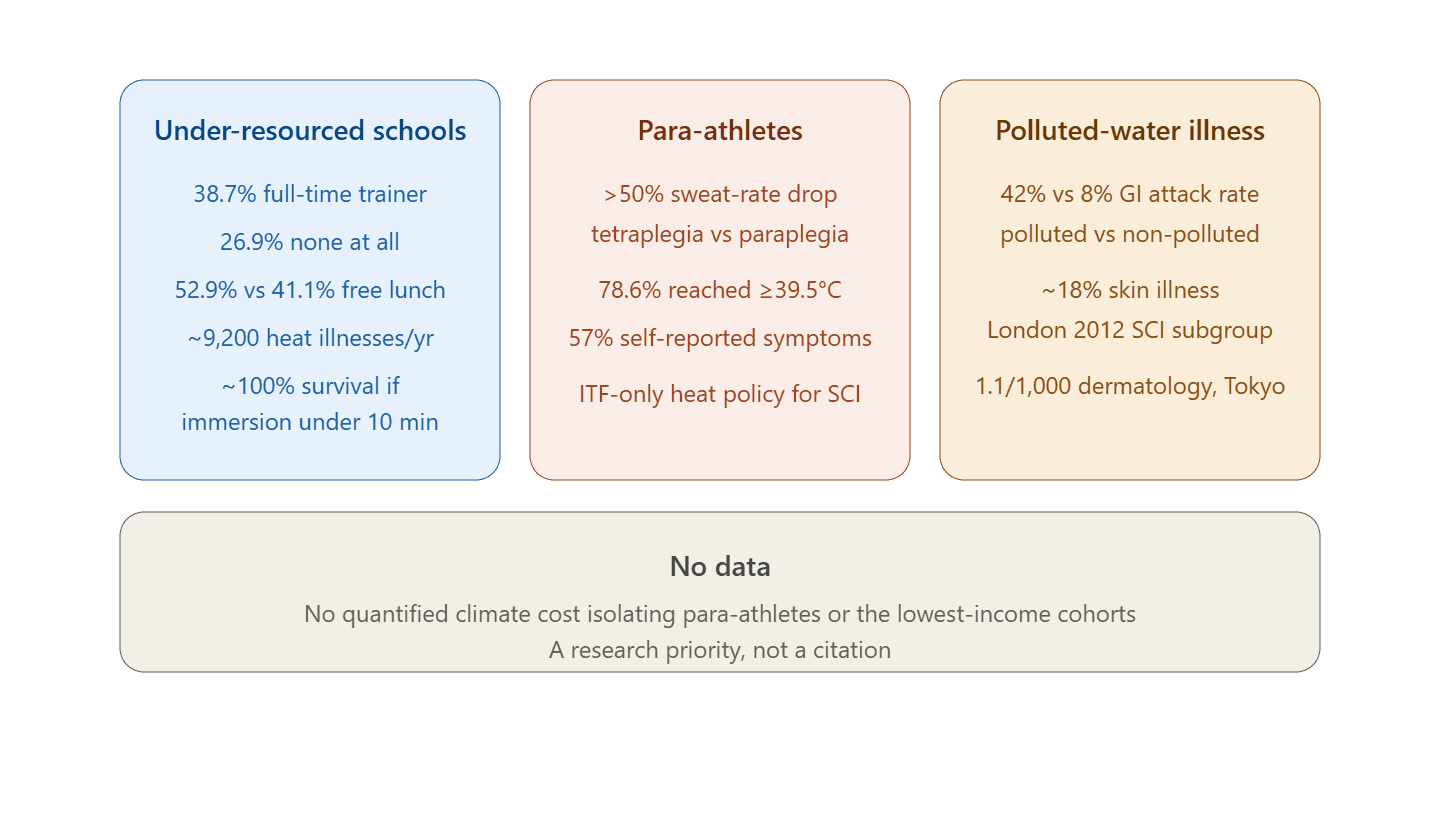
The clearest single data point sits in US schools. A study of 3,482 US public secondary schools (Barter et al., 2023) found only 38.7% had a full-time athletic trainer and 26.9% had none at all, and the schools with no trainer carried markedly higher free/reduced-lunch eligibility (52.9% vs 41.1%). The scope is precise: the sample drew from 15 selected states, so national is approximate. The pattern captured here is a socioeconomic gradient in on-site medical cover, not a measured worldwide outcome.
That gradient matters most under heat. An estimated 9,200 US high-school athletes experience time-loss heat illness annually, and survival from exertional heat stroke approaches 100% when cold-water immersion begins within about ten minutes of collapse. The two facts compound: the least-resourced athletes carry elevated heat exposure and are the least likely to have the one person on site whose presence converts a near-certain-survivable event into a fatal one.
Para-athletes sit at the most acute intersection. Spinal cord injury impairs sweating and heat dissipation: tetraplegia is associated with a more than 50% reduction in estimated whole-body sweat rate versus paraplegia, a figure deriving from a specific exercise-in-heat study of trained wheelchair athletes (Price & Campbell, 2003), not a universal or resting measurement. In paratriathlon data (28 mixed-impairment athletes racing in 33°C air), 78.6% reached a core temperature of 39.5°C or above and 57% self-reported heat-illness symptoms. Yet in this scan only one international federation, the International Tennis Federation, via its wheelchair-tennis regulations, had implemented a heat policy for spinal-cord-injury athletes, and even that lacked detailed risk-management guidance.
Polluted water compounds the danger for the same cohort. Insensate skin and prosthetic friction drive dermatological illness well above able-bodied rates: skin conditions reached up to around 18% of illnesses in the spinal-cord-injury subgroup at London 2012, and dermatology had the highest incidence of any organ system (1.1 per 1,000 athlete-days) at Tokyo 2020. A triathlon study found a 42% gastrointestinal-illness attack rate after swimming in sewage-polluted seawater versus 8% in non-polluted water (Harder-Lauridsen et al., 2013), the same pathogen exposure that, per Signal 2, decides whether aquatic events run at all.
The data gap is itself the finding. Robust aggregate economic figures exist (see Signal 4's £320m baseline), but this scan found no quantified cost estimate isolating the climate burden on para-athletes specifically, nor disaggregated data for the lowest-income cohorts. The literature itself describes para heat-risk evidence as notably limited and dermatological outcomes as underreported. This is not a citation we failed to locate; it is an absence, and absences in exactly the cohorts least able to fund their own protection are not neutral.
Signal 6: Climate Is Re-Pricing Sport's Assets, Up to ~$11bn Across NFL Stadiums by 2050
Climate X projects up to ~$11bn in cumulative climate losses across the 30 NFL stadiums by 2050 under a high-emissions scenario, with one venue alone modelled at 184% of its own replacement value.
The headline figure comes from a Climate X analysis projecting up to ~$11bn in cumulative climate losses across the 30 NFL stadiums by 2050 (high-emissions scenario), with MetLife Stadium alone at ~$5.65bn, 184% of its ~$3.07bn replacement value, meaning modelled climate losses exceed what it would cost to rebuild it. A separate Climate X analysis of 37 global venues, the 12 US 2026 FIFA World Cup venues plus the 25 largest European stadiums, projects losses rising from ~$130m (2020) toward ~$800m (2050). These are vendor scenario projections, not realised losses; this scan reports them as the asset-pricing signal they are, not as settled fact.
The stranded-asset template already exists elsewhere in sport. Low-altitude skiing is the clearest precedent: without snowmaking, ~53% of European resorts face very high snow-supply risk at +2°C, rising to ~98% at +4°C; with snowmaking on 50% of pistes, those figures fall to 27% and 71%. Coastal golf is following the same arc, with about 28% of the England & Wales coastline experiencing erosion above 0.1m/year. This scan reads ski and coastal golf as leading indicators of how physical exposure becomes financial exposure, not as evidence that the NFL or World Cup figures are themselves realised.
The liability layer is the part most often over-read, so this scan is deliberately strict about it. Heat-exposure liability is live but concentrated in youth and scholastic negligence, including a $10m settlement (2022) paid by a Georgia school district over the 2019 heatstroke death of 16-year-old student athlete Imani Bell. This scan does not support the generalisation that a professional-venue liability wave has arrived: no professional-tier exposure ruling was identified here. On the insurance side, carriers increasingly require loss-control and continuity plans as a condition of capacity, though sport-specific premium percentages remain qualitative and are not quantified in this scan.
Trend 1: The Ocean Has Shifted From Backdrop to Governing Layer
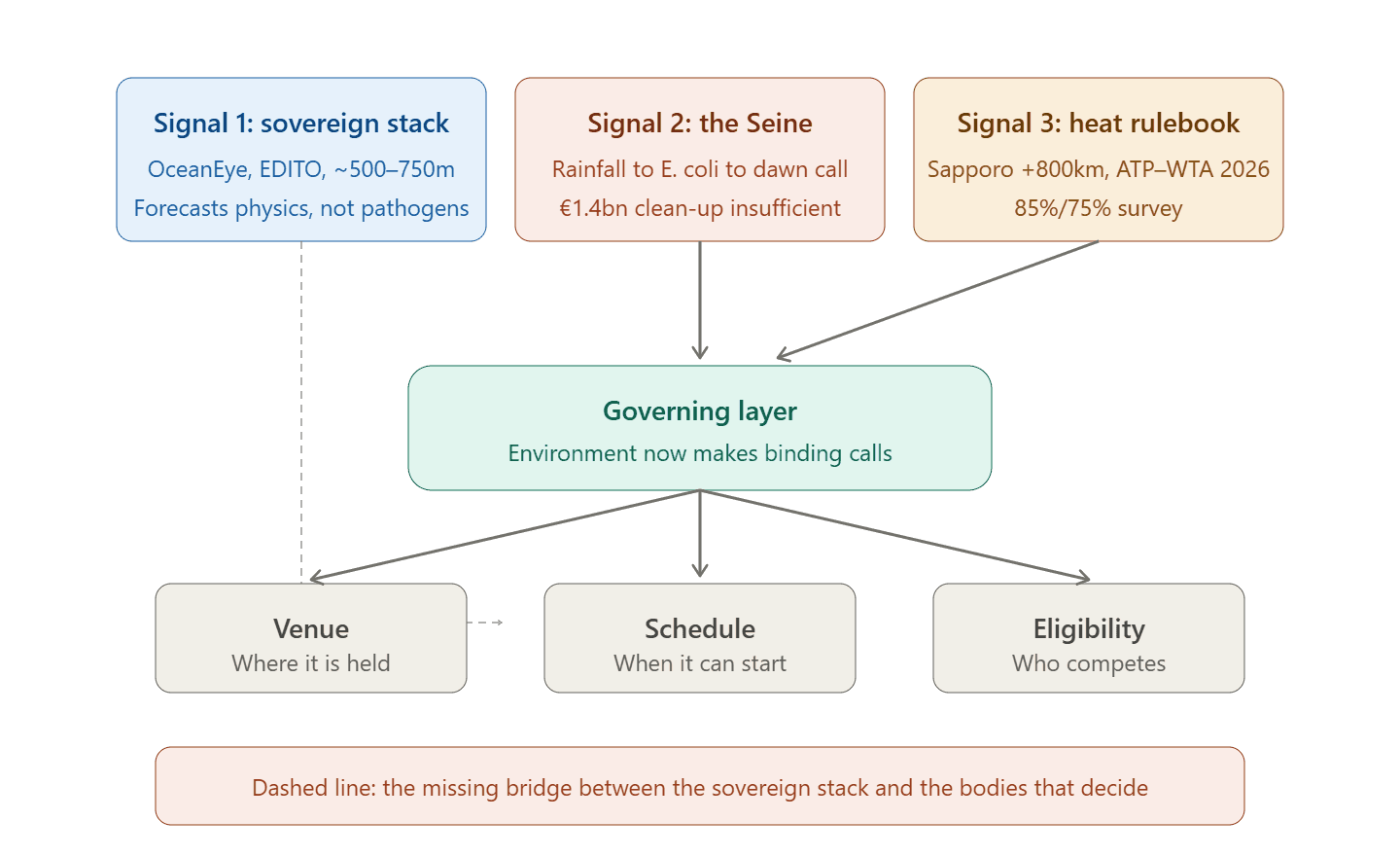
Three signals converge: sovereign ocean intelligence arrives (Signal 1), pathogens postponed the Paris 2024 triathlon (Signal 2), and heat has already rewritten the rulebook (Signal 3). The environment now decides venue, schedule and eligibility.
For most of its history, the ocean and the wider climate sat behind sport as scenery, the bay a regatta crossed, the river a city swam, the heat a marathon endured. What this scan captures across three otherwise separate signals is that the environment has stopped being scenery and become a condition: an input that gates who competes, where the event is held, when it can start, and how safely it can proceed at all. None of the three signals is, on its own, a claim about the future; each is a documented fact, and it is their convergence that constitutes the trend.
Signal 3 establishes that heat already governs eligibility, schedule and venue: the Tokyo 2020 collapses, the Olympic marathon relocated ~800km to Sapporo, the Doha 2019 DNF counts, and the 85%/75% World Athletics survey behind them, with WBGT thresholds now codified across tennis, athletics, open-water swimming and football and the ATP aligning to the WTA WBGT policy from the 2026 season. Signal 2 establishes that water quality governs the same way, and that the deciding variable is biological, not physical: the Seine breached the E. coli threshold after rainfall despite a ~€1.4bn clean-up, and the go/no-go calls were made reactively on daily dawn grab-samples. Signal 1 establishes that a sovereign intelligence layer now exists but forecasts the wrong variable: OceanEye, EDITO and Destination Earth model physics and biogeochemistry, not the faecal pathogens that decide aquatic events, and in this scan no institutional bridge was found between them and bodies such as World Triathlon or World Aquatics.
Read together, the three signals describe a single structural shift. The environment now gates sport along three independent axes at once: heat decides eligibility and schedule, water decides whether an aquatic event runs at all, and a sovereign forecasting capability that could anticipate all of this exists but is unconnected to the bodies that make the calls. This scan does not support the generalisation that every sport everywhere is now environmentally governed in the same degree; the strongest, best-evidenced cases are aquatic, endurance and heat-exposed disciplines. But within that bound the direction is unambiguous: the ocean and climate have moved from backdrop to governing layer, and the decisions are currently being made reactively, at dawn, against fixed thresholds, with the most relevant predictive variable left unforecast.
Trend 2: Prediction Is Commercialising Faster Than It Is Becoming Public
Two signals converge: the sovereign OceanEye/EDITO stack arrives (Signal 1) and the Seine postponed the Paris 2024 triathlon on a faecal-pathogen reading (Signal 2). Decision-grade forecasting exists, but in this scan it is overwhelmingly private and bespoke.
Take the two signals in sequence. Signal 1 is supply at sovereign scale: OceanEye, free and public by design, and underneath it EDITO already integrates Copernicus Marine and EMODnet data and runs AI forecasting, seasonal chlorophyll, wave and tide, a marine-plastic exposure tracker and a Communities at Risk tool, with Destination Earth's extremes twin zooming on demand to roughly 500 to 750m on a named location and event. Signal 2 is the demand that actually decides events, and it points where the sovereign stack does not: the Paris 2024 men's triathlon was postponed after the Seine breached the E. coli threshold, with go/no-go made reactively on daily grab-samples. The deciding variable was a faecal pathogen; the sovereign stack forecasts physics, not the pathogens that decide aquatic events.
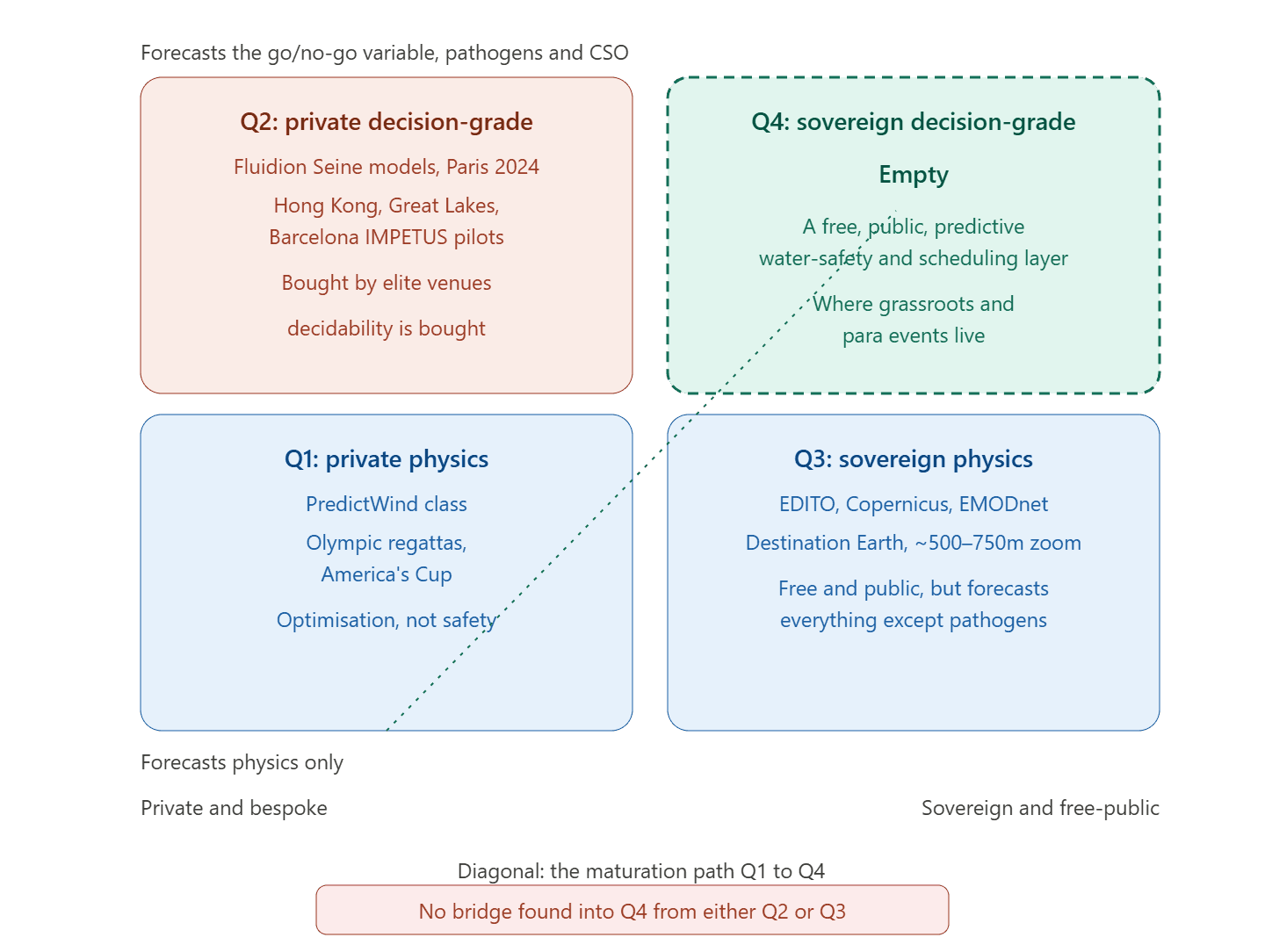
Where the two collide, the market has split into three clusters this scan can name, and the public, decision-grade quadrant is empty. First, mature private physics: PredictWind-class wind/wave/current forecasting already runs Olympic regattas and the America's Cup, proof that sport will buy bespoke prediction, but for optimisation, not safety. Second, private and fragmented decision-grade pathogen prediction: the bespoke Fluidion Seine models built for Paris 2024, plus scattered local pilots such as Hong Kong's beach-water forecast, US Great Lakes nowcast models, and Barcelona's combined-sewer-overflow early-warning pilot. Decision-grade pathogen forecasting therefore exists, but in this scan it was bought for one elite event or sits in disconnected municipal pilots. Third, the sovereign physics stack (EDITO, Destination Earth), free and public, but forecasting everything except the go/no-go variable.
The connecting line between any of this and aquatic-sport governance is the one this scan could not find. We found no evidence that the local pathogen pilots are tied to the sovereign EU platform, and no institutional bridge between Copernicus/EDITO/Destination Earth and bodies such as World Triathlon or World Aquatics. The shape of the gap matters: it is not that governing bodies sit low on a single readiness ladder, it is that two systems must meet and currently do not, sovereign-scale physics on one side, decision-grade pathogen prediction on the other, and the only place they have met so far is inside a bespoke, paid-for service procured by an Olympic host.
That is where the equity through-line lands directly: bespoke decidability is bought. Paris commanded Fluidion-style sensing because Paris could. The empty public quadrant is exactly where youth, amateur and para events live, the cohorts that will never afford bespoke pathogen modelling. A sovereign, free, predictive water-safety layer would not merely be an innovation; it would be the equity instrument, protecting the events that elite money already protects for itself. Commercialisation racing ahead of publication is therefore not a neutral sequencing problem; it is a distributional one.
Trend 3: Insurance and Liability Are Redrawing Sport's Viable Geography
Three signals converge: the regressive £320m UK grassroots bill (Signal 4), the adaptation gap deepest for para-athletes and under-resourced schools (Signal 5), and the ~$11bn NFL-stadium re-pricing (Signal 6). Exposure and adaptation capacity pull in opposite directions.
This is a reasoned convergence of three verified lines, not a single proven law; this scan does not find a single dataset that proves the inverse relationship as a measured global outcome.
The exposure side is hardening into balance-sheet numbers: up to ~$11bn across the 30 NFL stadiums by 2050, MetLife alone at 184% of replacement value, and 37 global venues rising from ~$130m toward ~$800m by 2050. Stranded-asset templates already exist outside the stadium, ~53% to ~98% snow-supply risk for European ski resorts at +2°C to +4°C, and ~28% of the England and Wales coastline eroding above 0.1m/year. The scan reads these as leading indicators of an asset class being re-rated, not yet a settled market.
The liability side is live but, in this scan, narrowly placed. Heat-exposure liability is real, a $10m settlement followed the 2019 heatstroke death of 16-year-old Imani Bell in Georgia, but concentrated in youth and scholastic negligence, not a professional-venue wave. Carriers increasingly require loss-control and continuity plans as a condition of capacity, though the sport-specific premium effect remains qualitative here. The governance scaffolding moves in parallel: WBGT thresholds spreading across tennis, athletics, open-water and football, with the ATP aligning to the WTA WBGT policy from the 2026 season, a shift this scan reads as guidance hardening toward a standard of care.
The adaptation side runs the other way, and this is the trend's load-bearing claim. Signal 4 establishes the regressive structure within one national line: £320m a year for UK grassroots sport, an additional £95m at 2°C and £190m at 4°C, and ~120,000 grassroots football matches cancelled annually in England. Signal 5 sharpens the same gap to the individual body: only 38.7% of US public secondary schools had a full-time athletic trainer, with no-trainer schools carrying markedly higher free/reduced-lunch eligibility; against ~9,200 US high-school athletes suffering time-loss heat illness annually, and exertional-heat-stroke survival approaching 100% with cold-water immersion within ~10 minutes, the least-resourced athletes carry the highest heat risk and are least likely to have anyone on site who can save them. Para-athletes sit at the most acute intersection, with a more than 50% sweat-rate reduction in tetraplegia versus paraplegia, 78.6% of paratriathletes reaching core temp 39.5°C or above, and only the ITF with a heat policy for spinal-cord-injury athletes.
The decisive finding is an absence. This scan found no quantified cost estimates isolating the climate burden on para-athletes or lowest-income cohorts. The exposure side is being priced in billions; the adaptation side for those most exposed is not being priced at all. That asymmetry, measured exposure against unmeasured, unfunded adaptation, is the mechanism by which capacity runs inverse to need, and the data gap is itself the finding.
The Gap: The Decisive Variable Is Governed by a Different System Than the One Being Built
This scan found no institutional bridge between Copernicus/EDITO/Destination Earth and any aquatic-sport governing body, and no public evidence of a free, predictive, decision-grade water-safety service. The gap is not a low rung on a readiness ladder; it is a specific empty quadrant.
A readiness ladder would tell us that aquatic-sport governance is behind and needs to climb. In this scan that framing misreads the failure. The problem is not that the bodies sit low on a single scale of preparedness, it is that two different things must meet and currently do not. The intelligence being built at sovereign scale (OceanEye, EDITO, Destination Earth) forecasts physics and biogeochemistry: currents, waves, tides, chlorophyll, coastal flooding, marine-plastic exposure. The variable that actually decides an aquatic event, the E. coli count judged against World Triathlon's 1,000 CFU/100mL threshold, driven by rainfall and combined-sewer overflow, is governed by an entirely separate, mostly reactive system of dawn grab-samples. Both can be mature, and the event can still be ungoverned, because the two never connect.
To map that precisely, we introduce a bespoke instrument. The Aquatic-Sport Governing-Layer Exposure Map is a proprietary analytical framework developed by Sport Singularity for this series. We state that openly: it is our product concept and our interpretive lens on the evidence, not an external standard or a finding reported by any source in this scan. The facts plotted on it trace to the verified evidence base; the axes, the quadrant logic, and the white-space diagnosis are ours.
The framework has two axes. The X-axis is sovereignty of the intelligence, from private and bespoke to sovereign and free-public: who controls and pays for the forecast. The Y-axis is decidability for aquatic events, from forecasts physics only to forecasts the go/no-go variable, the go/no-go variable being faecal pathogens and combined-sewer-overflow risk. Crossing them yields four quadrants, and the diagnosis lives in which one is empty.
The existing capability is real and well-evidenced; it simply sits everywhere except the quadrant that matters. Sovereign physics and biogeochemistry at scale exists (EDITO, Copernicus, Destination Earth's on-demand zoom). Bespoke decision-grade pathogen prediction for one elite event exists (the Fluidion Seine models for Paris 2024). Fragmented local pathogen pilots exist (Hong Kong, US Great Lakes, Barcelona). Mature private weather and ocean forecasting in sport exists (PredictWind-class, for optimisation, not safety). Reactive go/no-go governance exists (daily grab-samples against World Triathlon's threshold). And a funded sovereign cultural-engagement lane with a 2027 legislative moment exists (OceanEye's public-engagement pillar, EU4Ocean, Ocean Observation Week, and the forthcoming Ocean Act).
What is missing, not identified anywhere in this scan, is the quadrant that combines sovereign and free-public with decision-grade pathogen forecasting: a predictive pathogen pipeline fused into a forecast-led go/no-go and scheduling tool, with no public evidence of one operating; any institutional bridge between the sovereign stack and aquatic-sport governing bodies; a shared, forecast-based decision standard to replace reactive dawn grab-sampling; a free, public route to decision-grade water-safety intelligence for the youth, amateur and para events that will never afford bespoke sensing, which is the equity mechanism, not a separate story; sport's claim on the empty OceanEye cultural lane; and quantified climate-cost data isolating para-athletes and lowest-income cohorts.
The empty cell is not a high rung no one has climbed; it is a quadrant no one has occupied. Both routes into it are unbuilt, there is no bridge that adds the pathogen layer to sovereign physics, and none that makes the bespoke pathogen models free and public. The decisive observation is that in this scan decidability is bought: the only decision-grade pathogen prediction we found was the bespoke kit commissioned for one elite event. That is exactly why the empty public quadrant is where grassroots, amateur and para events live, with no affordable path to it.
To be precise about scope: this is a synthesis of individually well-evidenced components, and the gap is framed as an absence we could not find filled, not a proven non-existence. Each component traces to the verified base; the claim no bridge found is bounded to this scan. This scan does not support the generalisation that no such service could exist or is being attempted privately, only that none surfaced in the public evidence reviewed.
Wild Card 1: The First Professional-Tier Athlete Wins a Heat-or-Pollution Liability Ruling
A professional-tier athlete, or their estate, brings and wins a negligence claim over heat or polluted-water exposure at a sanctioned elite event, breaking liability out of the youth and scholastic pattern. No professional-venue precedent was identified; this is an anticipatory claim, not an observed one.
This is a scenario assessment, not a prediction.
The trigger has three legs, and what makes it non-linear is that they are independently maturing and would only need to align once. The first is an existing liability template, confined to youth and scholastic negligence: the $10m settlement (2022) over the 2019 heatstroke death of 16-year-old Imani Bell. It establishes that a duty-of-care breach over heat exposure is litigable and expensive, but only below the professional tier. The second is the hardening of environmental thresholds from guidance into something that looks, in court, like a standard of care: World Triathlon's 1,000 CFU/100mL E. coli threshold, and WBGT heat protocols now formalising across tennis, athletics, open-water and football, with the ATP aligning to the WTA WBGT policy from the 2026 season. Once a federation writes a numeric threshold, a plaintiff can argue that crossing it and proceeding anyway is negligence per se. The third is documented exposure at the elite level itself: the Paris 2024 postponement, the Tokyo 2020 collapses, the Doha 2019 DNF counts, and the 2023 US Open heat. The evidentiary record of harm at sanctioned elite events already exists; what does not yet exist is a winning professional-tier suit that fuses these legs into precedent.
The non-linearity is in the second-order effect, not the verdict itself. A single adverse ruling would not merely add one liability; it would reclassify federation thresholds from advisory guidance into an enforceable standard of care overnight, and that reclassification is what carriers price against. This is why the scenario is high-impact despite low near-term probability: the change is a phase shift in legal status, not an incremental cost.
The early weak indicators to watch are unglamorous and already in motion: an insurer's capacity clause requiring loss-control, federations formalising WBGT into binding protocol, a pro-level suit surviving dismissal, an event cancelled then contested on the data. This wild card pairs with Trend 3: if it materialises, it accelerates exactly the re-pricing Trend 3 describes, with the viable geography of elite events contracting toward venues and dates that are defensible in court, the same dynamic that, on the equity axis, pushes the least-resourced and most-exposed cohorts out first.
Wild Card 2: A Pathogen Cluster at a Marquee Open-Water Race Makes the Sport Un-Sanctionable Without a Forecast
A marquee open-water or triathlon event proceeds, or is reactively cancelled too late, and a cluster of competitors suffers serious illness from a warming-amplified pathogen, turning an abstract trend into a single, televised, attributable harm.
This is a scenario assessment, not a prediction.
Three legs hold this scenario up, each independently evidenced in this scan. The first is the warming-amplified hazard itself: Vibrio vulnificus, which thrives in warm brackish water, rose roughly eightfold in the eastern US between 1988 and 2018, with the northern extent of cases shifting north about 48km a year and wound-infection fatality as high as ~18%. One Netherlands modelling study finds Vibrio concentrations rise by a factor of ~1.5 per °C; this scan flags that as a single-study figure, not a universal constant, while noting other studies project larger increases. The second is the documented attack rate that makes a cluster credible: a 42% gastrointestinal-illness attack rate after swimming in sewage-polluted seawater versus 8% in non-polluted water (Harder-Lauridsen et al., 2013). The third is the detection gap: go/no-go calls are still made reactively, via daily dawn grab-samples judged against fixed thresholds, as at Paris 2024. A grab-sample tells you about the water that was tested, at the time it was tested; it does not forecast the water athletes will swim in.
The non-linearity sits in that gap. The underlying hazard trend is a slow, continuous climb, northward range expansion, rising concentrations per degree of warming. But the event is discontinuous: it converts a statistical trend into a named, attributable harm at a marquee venue, on camera, with identifiable victims. That is the mechanism that flips a nice-to-have forecasting capability into a precondition for holding the event at all. The scan does not support the claim that this is likely; it supports the claim that the hazard is rising and the detection method is structurally blind to the variable that decides events.
A bounding note this scan insists on: the plastisphere-to-athlete-infection chain, microplastics as a vector for antibiotic-resistant pathogens, is plausible and growing in the literature but is not demonstrated to cause documented athlete infection, and is therefore not treated as a present-day hazard here.
This wild card pairs with Trend 1. If it materialises, it is the hardest possible expression of Trend 1: the deciding variable for whether a race can be held is a pathogen the sovereign ocean stack forecasts everything around but not directly. It would force the empty quadrant from optional white space to mandatory infrastructure, and harden the ocean's role from condition to gatekeeper.
So What Now?
The report does not advocate for a specific policy outcome. It ends on a position, and three operational directions follow from it.
Across six signals and three trends, one shape kept recurring: the environment now governs sport, the sovereign intelligence to anticipate it now exists, and the two have not been introduced to each other. The forecast that decides whether an aquatic event can safely run is governed by a different system than the one being built at continental scale, and no institutional bridge between them was found.
Aquatic-sport governing bodies may treat the variable that actually decides their events as a forecasting question, not only a sampling one. Reactive dawn grab-sampling worked at Paris 2024 within its design, but it is a snapshot of yesterday's water used to decide today's race. The bodies that write numeric thresholds, World Triathlon's 1,000 CFU/100mL among them, are the ones with the standing to ask whether a forecast-led standard could sit alongside the reactive one. That question is theirs to open, and this scan found no one yet asking it at governing-body tier.
National sport funders, event organisers, and the cohorts most exposed may treat decision-grade water-safety intelligence as an equity question rather than a procurement line. Paris commanded bespoke Fluidion-style sensing because Paris could; the youth, amateur and para events that need it most cannot. Where a forecast is available only to those who can buy it, the viable geography of sport contracts toward whatever is cheapest to defend. Making the adaptation side legible, and the forecast public, is the corrective this scan keeps returning to.
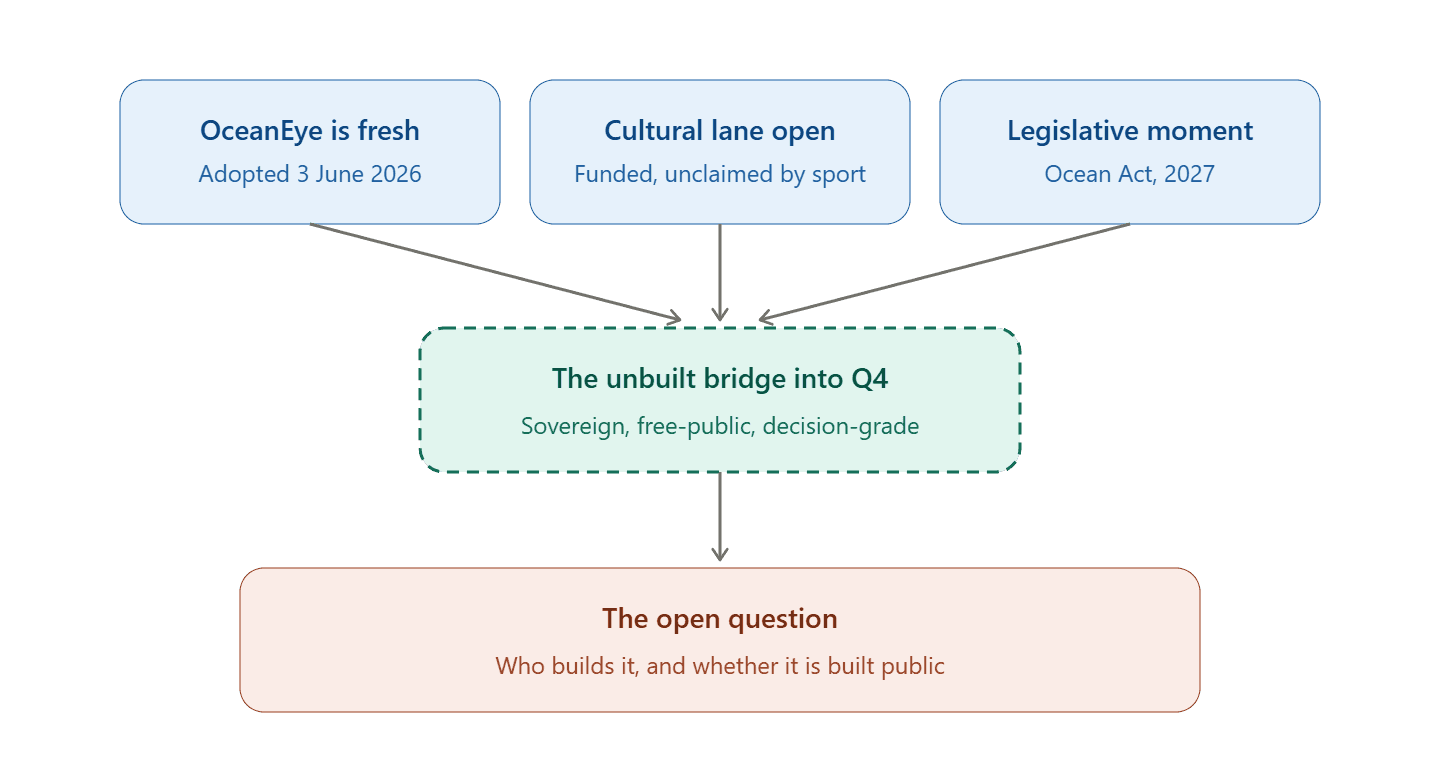
The Aquatic-Sport Governing-Layer Exposure Map offered in this report is one scaffold for reading that landscape. It is a scan finding and a Sport Singularity product concept, not a third-party instrument, and we state the editorial argument and the product positioning together rather than separately, in the interest of disclosure. What it locates is a single empty quadrant: sovereign, free-public, decision-grade forecasting of the variable that decides aquatic events. OceanEye is fresh, its cultural-engagement lane funded and unclaimed by sport, and a 2027 Ocean Act legislative moment is approaching. The bridge into that quadrant is still unbuilt, which is precisely why it is still buildable. Whoever builds it will not be improving sport's relationship with the ocean; they will be shaping who gets to compete in it. So we leave the question where it belongs: who should that be?
This article is part of the SF4Sport Strategic Foresight Series by Sport Singularity. The analysis draws on 52 audited sources, peer-reviewed research, EU primary instruments and programme documentation, national and institutional reports, and quality journalism (2003 to 2026), and maps the emerging sovereign ocean-intelligence stack including OceanEye, the European Digital Twin Ocean, Destination Earth and Copernicus Marine against the governing thresholds of aquatic and heat-exposed sport.
June 2026, Sport Singularity, SF4Sport
Bibliography
Alma Economics and DCMS (2025). Exploring the financial implications of climate change on grassroots sport. GOV.UK, September 2025.
ATP Tour (2025). New heat rule effective from 2026.
Barter, E. W. et al. (2023). Athletic trainer access and socioeconomic factors in US secondary schools. PMC10072086.
Bloomberg (2024). How Paris cleaned up the Seine ahead of the 2024 Olympics.
Burgess, K. et al. (2004), via ClimateChangePost. United Kingdom coastal erosion.
CBS News (2021). Tokyo Olympics tennis: Daniil Medvedev heat warning; Paula Badosa in wheelchair.
CDC MMWR. High-school heat-illness surveillance.
Climate-ADAPT (EEA). Securing bathing-water quality in Barcelona.
Climate X (2024). Report projects $11 billion financial losses for NFL stadiums by 2050 due to climate risks.
Climate X (2024). Report projects $800 million in climate-related losses for FIFA World Cup venues by 2050.
CNN (2022). Imani Bell heat-death settlement, Georgia ($10m).
Connectsport. Climate change could make grassroots sport elitist (research).
Copernicus Marine. MEDSEA biogeochemistry analysis and forecast (MEDSEA_ANALYSISFORECAST_BGC_006_014).
DG MARE, European Commission. OceanEye programme page.
ECMWF. Destination Earth Digital Twin: weather-induced and geophysical extremes.
EDITO. European Digital Twin Ocean.
EPRS / EP Think Tank (2025). The European Ocean Pact and an Ocean Act by 2027.
ESPN (2019). Tokyo 2020 marathon move to Sapporo finalised amid controversy.
Euronews (2023). "One player is going to die": how extreme heat is affecting US Open tennis players.
European Commission (2026). OceanEye: placing the EU at the forefront of ocean observation. 3 June 2026.
Harder-Lauridsen, N. M. et al. (2013). Gastrointestinal illness among triathletes after swimming in polluted seawater. PLOS One. PMC3820603.
Korey Stringer Institute (UConn). Exertional heat stroke and cold-water immersion.
Met Office. Climate and football.
Nature, Scientific Reports (2023). Vibrio vulnificus eastern-US rise and northward shift.
Nature Climate Change (2023). Coastal and ski snow-supply risk.
NPR (2024). Paris 2024 triathlon Seine pollution delay.
PMC12854712. London 2012 and Tokyo 2020 dermatological illness incidence.
PMC7739687. Paratriathlon heat study (78.6% ≥39.5°C, 57% symptoms).
PredictWind. Sailing weather forecasting.
Price, M. J. and Campbell, I. G. (2003). Thermoregulatory responses of spinal-cord-injured and able-bodied athletes to prolonged exercise in the heat.
Rapid Transition Alliance (2020). Playing Against the Clock.
Round Our Way. Almost 3 in 4 football fans affected by weather cancellations.
Sport Resolutions (2025). ATP to introduce new heat policy in 2026.
SwimSwam (2024). Assessing the presence of E. coli in the Seine for the Olympic triathlon.
SwimSwam (2024). World Aquatics cancels Seine training session; more triathletes register GI illnesses.
The Conversation (2022). Heat risk and young athletes: rising temperatures lead to lawsuits and environmental injustice.
US EPA. Climate change and freshwater harmful algal blooms.
Vibrio sensitivity modelling: MDPI Microorganisms (2025). Vibrio ~1.5×/°C sensitivity (Netherlands study).
Wisconsin DNR. Beach water-quality prediction.
World Athletics (2023). Climate-change impact survey (85%/75%).
World Athletics (2019). Doha 2019 marathon results (DNF counts).