
The global AI in sport market reached €9.8 billion in 2025 and is projected to exceed €55 billion by 2034. The technology is already reshaping how athletes train, how coaches decide, and how clubs operate. But behind this transformation, a quieter crisis is building: the people responsible for sport, coaches, volunteers, administrators, are being asked to navigate a world of algorithms, data streams and automated decisions without the knowledge, tools or frameworks to do so.
Using our SF4Sport methodology, the work involved three interconnected layers:
Environmental scanning: identifying signals of change, emerging trends and potential wild cards across the AI and sport education landscape in Europe.
Policy alignment: mapping these findings against the EU AI Act, the IOC Olympic AI Agenda 2024, and GDPR as they apply to sport organisations.
Evidence synthesis: reviewing peer-reviewed sources published between 2020 and 2026, alongside academic literature, market reports and international policy documents.
The picture that emerged reveals a sector at a crossroads: powerful tools are arriving faster than the understanding required to use them responsibly. Here are 5 signals, 3 trends and 2 wild cards likely to shape the future of AI in sport.
Signal 1 — The Algorithm Is Already in the Room. The Coach Doesn't Know What It's Doing.
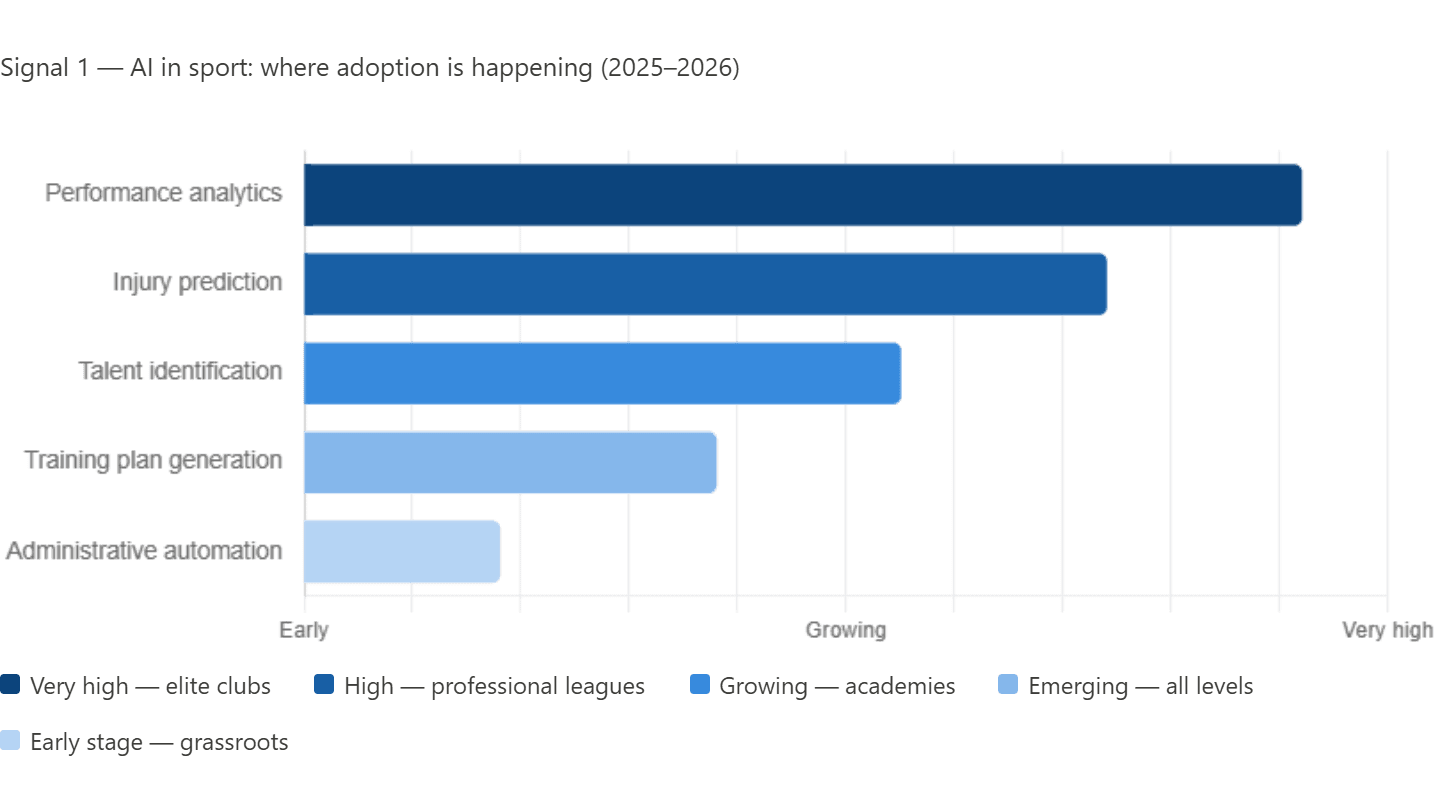
Performance analytics, injury prediction systems, talent scouting algorithms, AI has moved from experimental to operational in sport at every level. A 2025 systematic review of 40 academic studies found that AI adoption in sports coaching is outpacing the development of understanding among those using the tools. Coaches engage with outputs. Almost none interrogate the process behind them.
The black box problem is real: outputs are trusted, processes are not understood. A 2025 study assessing elite coaches found that while most could evaluate AI-generated training plans against their own experience, they consistently struggled to interrogate the reasoning behind recommendations. When an AI recommendation leads to a poor outcome, an injury, an underperformance, a missed talent, the coach bears accountability for a decision they did not fully control.
AI literacy is no longer optional continuing professional development. It is a safeguarding issue for coaches and athletes alike.
Signal 2 — The Elite–Grassroots Divide Is Becoming Structural.
The AI in sport market is growing at 21% annually. Nearly all of that growth is concentrated at professional and elite level. A Deloitte survey found that around 40% of smaller sports leagues still report limited understanding of analytics tools. An audit across 114 Olympic training centres found broad readiness gaps despite hardware availability.
Smaller clubs face a different reality entirely. High implementation costs, no dedicated staff, no legal capacity to manage data governance, and no safe space to experiment. The gap between a Champions League club and a community football team was always significant. AI is making it structural.
Graduate programmes producing professionals with both AI expertise and sport science understanding cannot keep pace with demand, a pipeline that will remain thin through at least 2028.
The divide is no longer about access to facilities or funding. It is about the capacity to understand, govern and benefit from technology.
Signal 3 — Athlete Data Is Being Collected. Ownership Is Unclear.
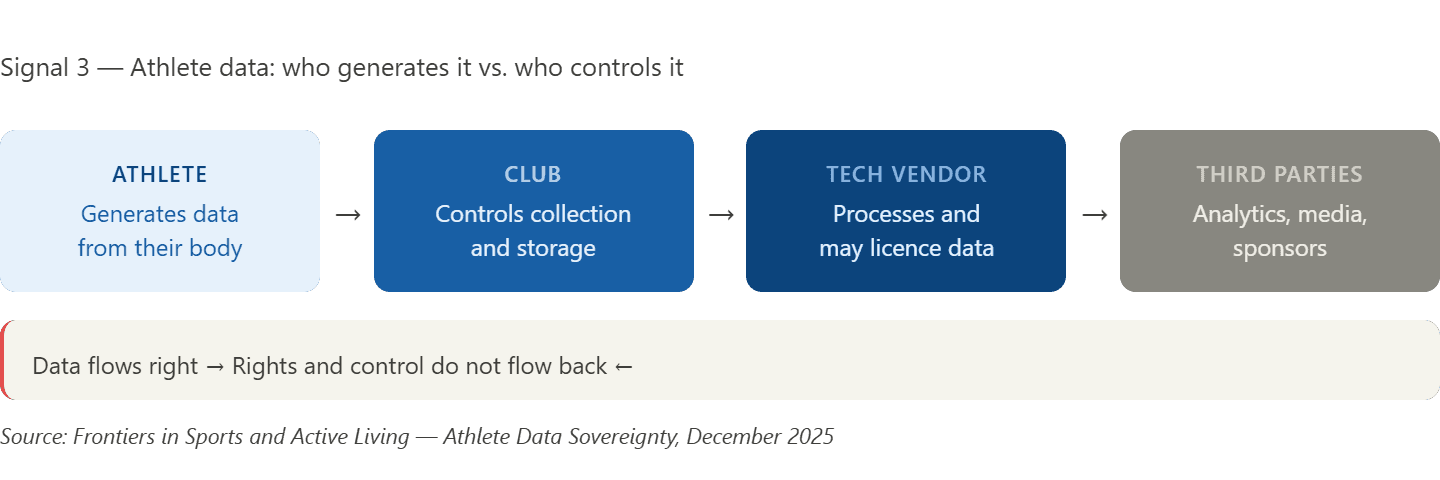
Wearable technology, computer vision systems and AI-linked sensors now generate continuous biometric and tactical streams from athletes at every level. A peer-reviewed study published in December 2025 found that most existing contracts treat athlete-generated data as institutional property rather than an extension of the athlete's person. Consent processes are formal rather than substantive. Athletes generate the data. Institutions own it.
Under GDPR, biometric data carries special category protections. In practice, academic research confirms that power asymmetries between athletes and organisations make exercising those rights extremely difficult. The data is flowing. The governance is not keeping up.
The line between performance monitoring and surveillance is becoming harder to define, and sport has not yet drawn it.
Signal 4 — Sport Has No Ethical Framework for AI. And the Research Confirms It.
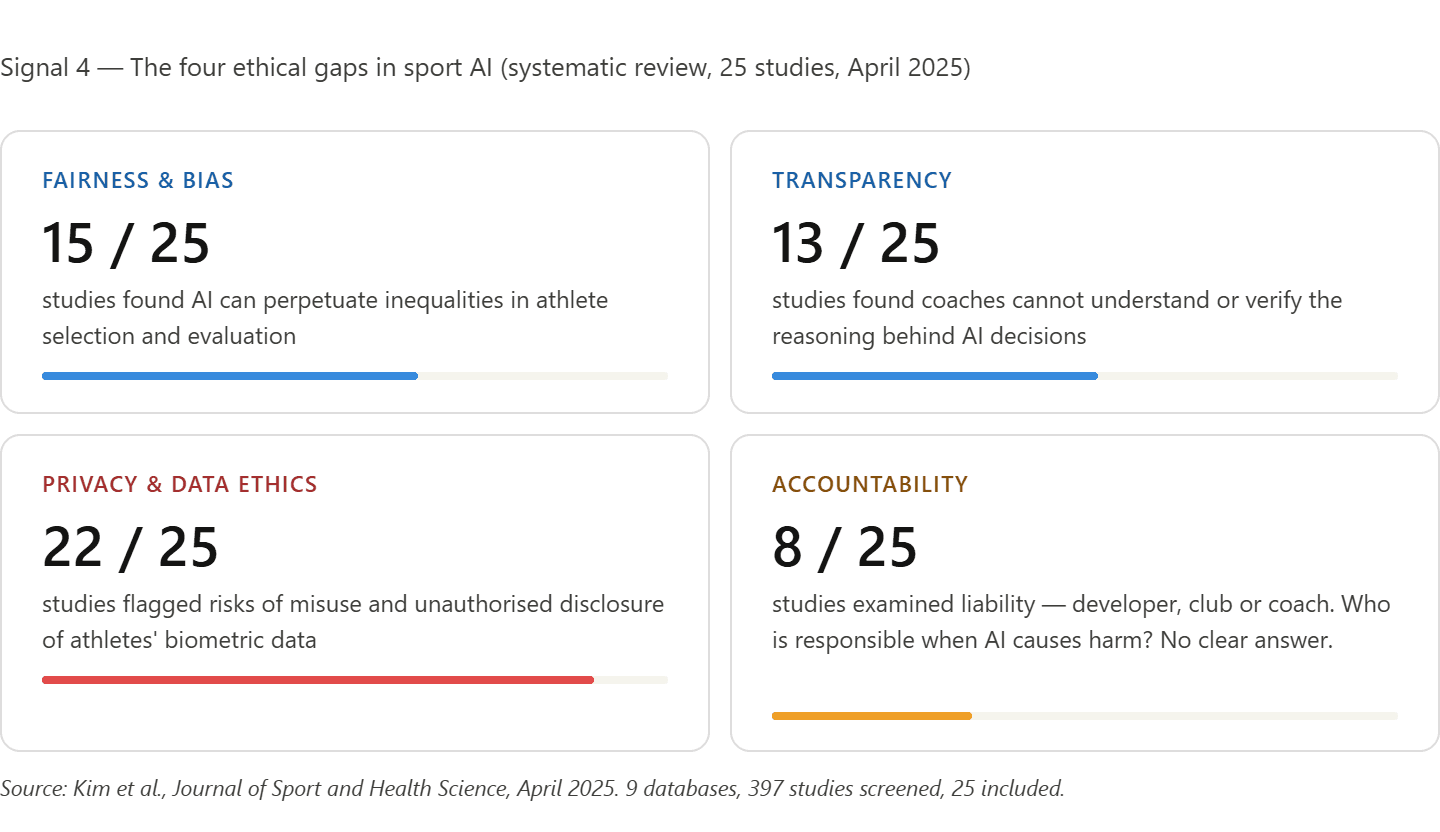
A systematic scoping review published in April 2025, examining 25 peer-reviewed studies across nine major academic databases, identified four dominant ethical concerns in AI's application to sport: fairness and bias, transparency and explainability, privacy and data ethics, and accountability. The authors concluded that ethical issues in sport AI are being discussed "at a minimal level" relative to the pace of adoption.
No sport-specific AI ethics framework exists. The EU AI Act provides general principles. The IOC's Olympic AI Agenda, introduced in 2024, acknowledges the issue. But the practical question, when an AI-informed decision harms an athlete, who is responsible?, remains legally and ethically unanswered.
Sport is making consequential decisions through AI before it has designed the governance to own them.
Signal 5 — Volunteers Run European Sport. Nobody Is Training Them for AI.
The majority of sport in Europe is delivered by volunteers. Coach recruitment and volunteer retention are among the top concerns cited in European sports club surveys. Digital skills capacity, the ability to adopt and manage new technology, sits alongside financial difficulty as a primary barrier to development for grassroots organisations.
AI training programmes, where they exist at all, target professionals in elite environments. The volunteer coach running a youth athletics club on Tuesday evenings has no pathway to AI literacy that fits her time, budget or context. The fastest-growing technology in sport is arriving at grassroots level without any preparation for the people who will need to use it.
The people who deliver sport every day are being left behind by the technology that is supposed to serve them.
Trend 1 — AI Is Moving from the Training Pitch to the Boardroom.
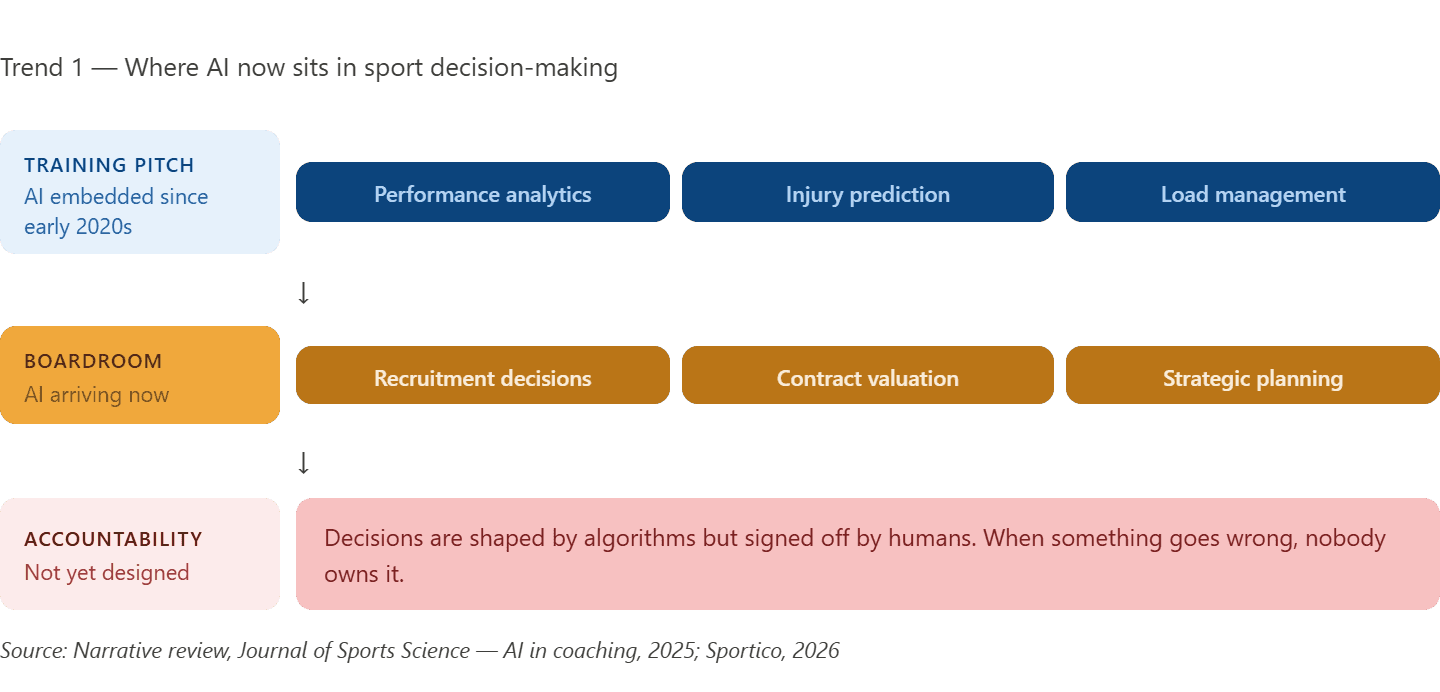
What began as performance analytics is now penetrating recruitment, contract valuation and strategic planning. A zone is forming where decisions are shaped by algorithms but signed off by humans. When that process leads to harm, a player released, a talent missed, a career shaped by a flawed model, the accountability architecture to respond simply does not exist yet.
Sport is making consequential decisions through AI before it has designed the governance to own them. The accountability structures of sport governance have not been redesigned for this reality. When a contract is terminated, or a young athlete is passed over, on the basis of AI-informed analysis, the institutional and legal implications remain largely unexplored.
AI is already in the boardroom. The rules for using it are not.
Trend 2 — Sport Education Has No AI Curriculum.
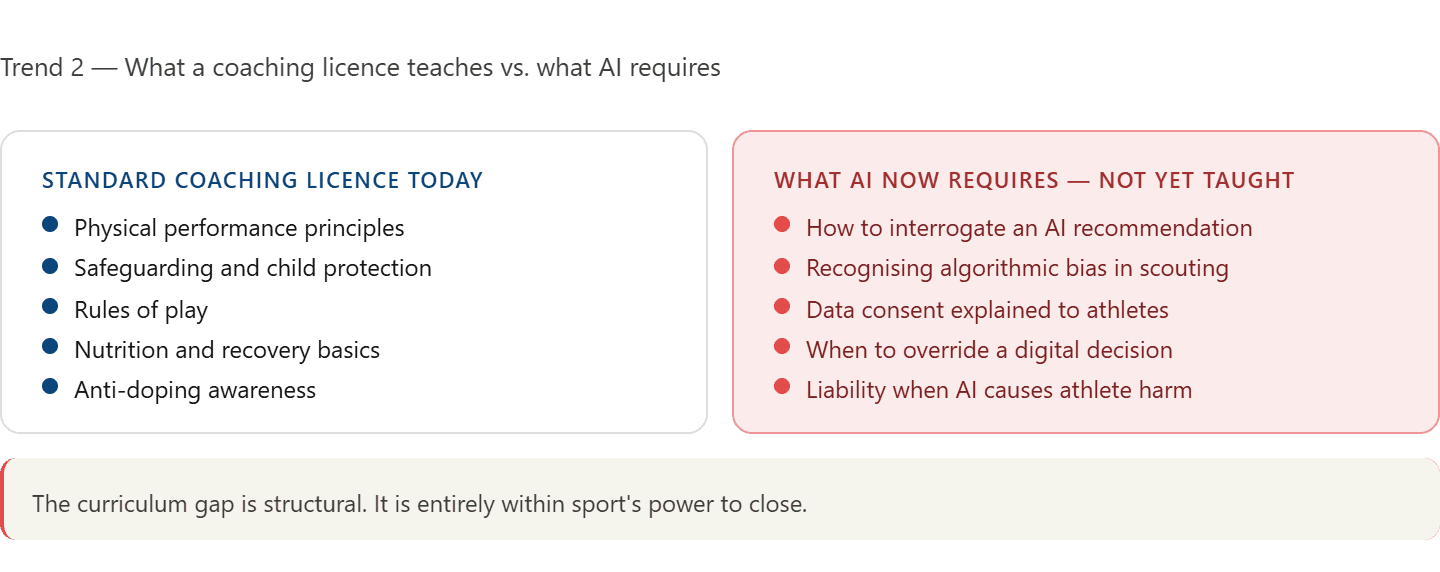
Coaching licences, federation certification programmes, and volunteer training pathways have been built around physical performance, safeguarding and rules of play. None have systematically integrated AI literacy. A coach completing a UEFA B Licence today will learn nothing about how to interrogate an AI-generated training load recommendation, assess whether a scouting algorithm encodes bias, or explain data consent to an athlete's family.
This is not a critique of individual institutions. It is a structural absence, and structural absences, unlike technology gaps, are entirely within sport's power to close.
Sport has built strong education pathways over decades. Safeguarding frameworks, anti-doping curricula and inclusion training have all been systematically embedded in professional development pathways. The mechanism exists. The habit exists. The institutional infrastructure exists. What does not yet exist is an equivalent pathway for AI.
The curriculum gap is structural. It is entirely within sport's power to close.
Trend 3 — Compliance Cost Is Becoming an Existential Pressure for Small Clubs.
GDPR compliance, data processing agreements, AI ethics obligations and vendor due diligence: responsible AI adoption requires both knowledge and budget. Large clubs manage this with legal teams. Volunteer-run clubs cannot. GDPR violations can trigger fines of up to €20 million or 4% of annual turnover. For a community sports club, either figure is terminal.
As AI becomes more embedded in youth development, competition management and talent identification, clubs that cannot demonstrate responsible data practice face growing reputational and regulatory exposure, for decisions they often did not know they were making.
Small clubs are not choosing to ignore AI compliance. They simply have no capacity to address it.
The Gap — Prevention Works in Sport Education. Not Yet in AI.
Sport has a strong tradition of structured coach education. Safeguarding frameworks, anti-doping curricula and inclusion training have all been systematically embedded in professional development pathways. The mechanism exists. The habit exists. The institutional infrastructure exists.
What does not yet exist is an equivalent pathway for AI. Evidence-based sport coach education programmes have demonstrated strong outcomes in behaviour change and professional practice across 16 meta-analyses. None of them have been adapted to address the specific challenges of AI tools: how to read an algorithm's output critically, how to govern athlete data responsibly, how to recognise when a digital system is making a decision that should remain human.
The gap is not a technology gap. It is a curriculum gap, and curriculum gaps are within sport's power to close.
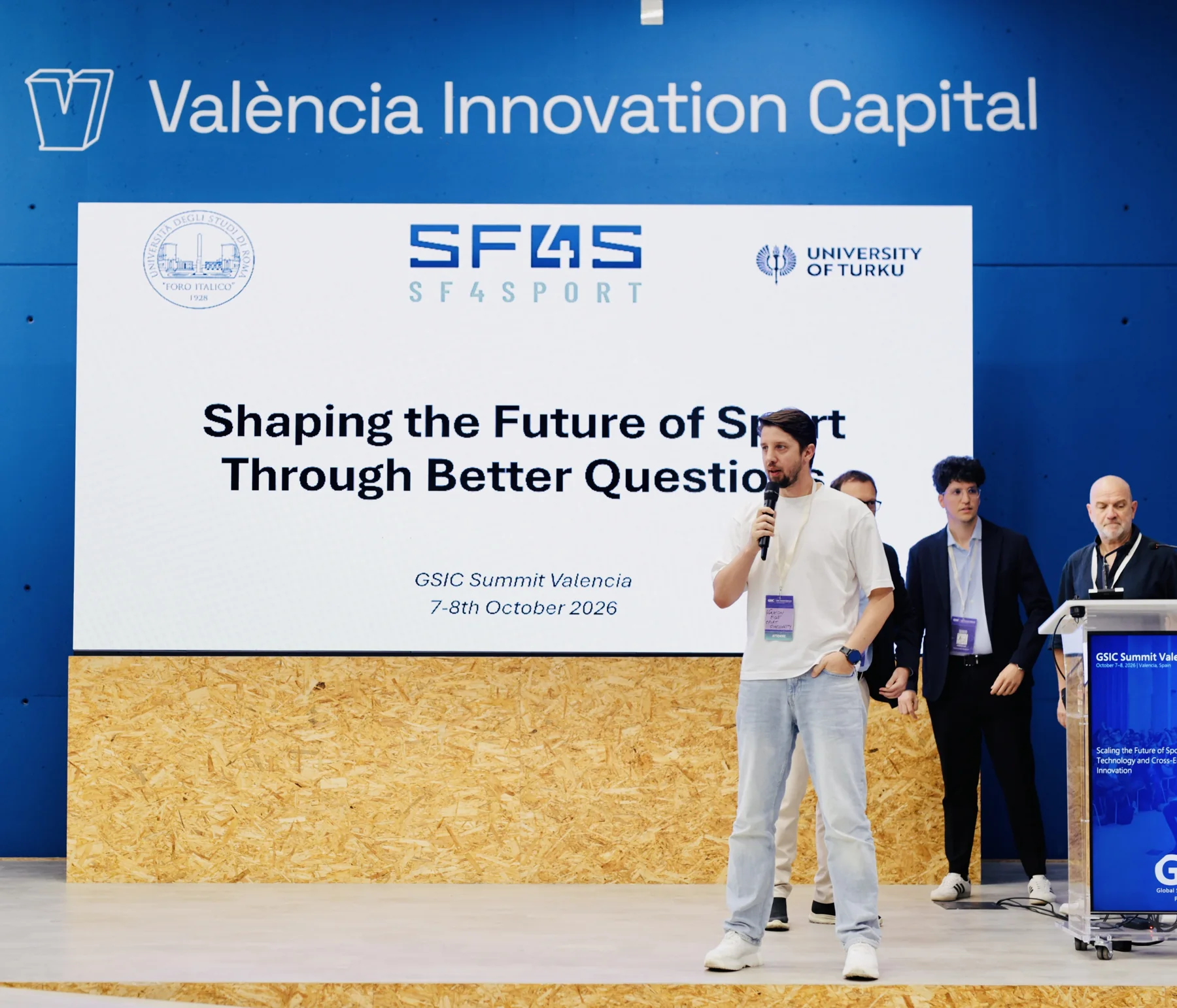
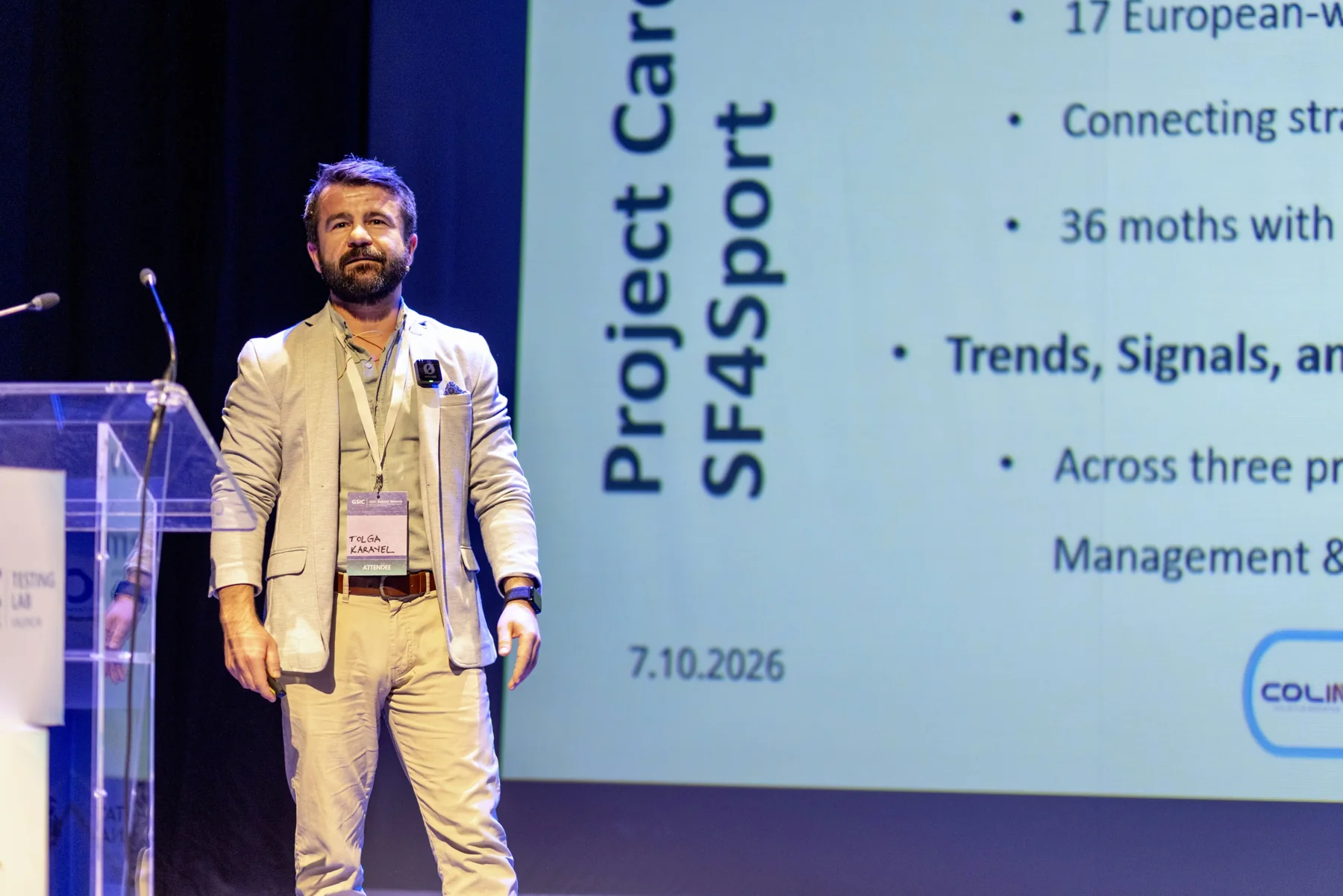
This is precisely the gap that the SF4Sport project has been designed to address. Funded by the European Commission under the Erasmus+ Alliances for Innovation strand and coordinated by Collective Innovation, with Sport Singularity as a contributing partner, SF4Sport applies a strategic foresight methodology to examine how European universities and sport education curricula must evolve in response to the AI transformation reshaping the sector.
The tools to close this gap already exist in other domains. The opportunity is to design sport-specific versions.
Wild Card 1 — What If AI Ends a Young Athlete's Career?
A wild card is a low-probability, high-impact event that could disrupt the entire landscape overnight.
AI talent identification systems are active across youth academies, national federations and scouting networks. Academic evidence already documents that such systems can encode existing biases, replicating historical patterns of exclusion based on body type, ethnicity or socioeconomic origin. A 2025 narrative review of 24 studies on AI-driven injury prediction found that few systems offer robust ethical safeguards or athlete-centred governance structures.
What has not yet happened, publicly, is a high-profile case where a young athlete demonstrates that an AI system made a consequential decision about their career without adequate human review, transparent methodology or right of appeal. When that case arrives, the sport sector will be asked to answer for accountability structures it has not yet built.
The probability is high, within a 1 to 3 year window. The impact, if realised, would be disruptive. The key tension is between adoption speed and accountability architecture.
When the first case arrives, sport will be asked to answer for governance structures it has not yet built.
Wild Card 2 — What If Sport Is Already Training Someone Else's AI?
Every match played, every session recorded, every metric logged generates data that is valuable far beyond the pitch. Video footage trains computer vision models. Movement data trains biomechanical algorithms. Tactical sequences train decision-making systems. The commercial value of this data, as training material for AI systems, is significant and growing.
Most clubs and federations have not asked the relevant question: where does their data go after it passes through a third-party vendor? Many technology licences include rights to aggregate, anonymise and use data for model development. Athletes have not consented in any meaningful sense.
The probability is medium, within a 2 to 5 year window. The impact, if realised, would be transformative. The key tension is between data sovereignty and commercial dependency.
If sport is already functioning as an unpaid data provider for commercial AI infrastructure, the implications reach well beyond privacy law.
So What Now?
These signals and trends make one thing very clear: AI in sport is not a future challenge. It is a present reality that sport's education and governance infrastructure has not yet caught up with.
Three priority areas emerge from the analysis:
Priority 1 — AI Literacy for All Roles in Sport
Coaches, volunteers and administrators need accessible, sport-specific AI training. Not a single programme for everyone, but a pathway that meets people where they are, from the volunteer coach on Tuesday evenings to the federation director making recruitment decisions informed by algorithmic outputs. The tools and pedagogy exist. What is needed is sport-specific adaptation and institutional commitment to deliver it.
Priority 2 — Sport-Specific Ethical Frameworks for AI
General AI governance principles, the EU AI Act, the IOC Olympic AI Agenda, do not account for the unique dynamics of athletic performance, bodily risk and competitive fairness. Sport needs its own accountability and transparency standards: who is responsible when an AI-informed decision harms an athlete? How should algorithmic outputs be disclosed to athletes? What constitutes meaningful consent for biometric data collection? These questions require sport-specific answers.
Priority 3 — Data Sovereignty for Athletes
Clear, enforceable governance of athletic data from collection through to commercialisation, starting with meaningful consent and ending with the right of athletes to know how their data is used, shared and potentially monetised. This is not only an ethical obligation. It is a legal one under GDPR, and one that many sport organisations are currently failing to meet.
This article is a part of the SF4Sport Strategic Foresight Series by Sport Singularity. The analysis draws on peer-reviewed sources (2020–2026) and maps international policy frameworks including the EU AI Act, IOC Olympic AI Agenda 2024, and GDPR.
April 2026, Sport Singularity, SF4Sport
Academic and Peer-Reviewed Research
Glebova, E., Su, Y., Desbordes, M. and Schut, P.-O. (2025). Editorial: Emerging digital technologies as a game changer in the sport industry. Frontiers in Sports and Active Living, 7, 1605138. DOI: 10.3389/fspor.2025.1605138.
Jud, M. and Thalmann, S. (2025). AI in digital sports coaching — a systematic review. Managing Sport and Leisure, 30(6), 1577–1593. DOI: 10.1080/23750472.2024.2449016.
Kim, J.-H., Kim, J., Kang, H. and Youn, B.-Y. (2025). Ethical implications of artificial intelligence in sport: A systematic scoping review. Journal of Sport and Health Science, 14, 101047. DOI: 10.1016/j.jshs.2025.101047.
Koh, K.T., Newman, T.J. and Santos, F. (2026). Editorial: Digital transformation in sports coaching — enhancing coach learning and athlete development. Frontiers in Sports and Active Living, 8, 1785591. DOI: 10.3389/fspor.2026.1785591.
O'Brien, K.A. and Prentice, S. (2025). Assessing the practicality of using freely available AI-based GPT tools for coach learning and athlete development. Frontiers in Sports and Active Living, 7, 1627685. DOI: 10.3389/fspor.2025.1627685.
Özsari, A., Tek, T., Uysal, H., Genç, M., Toros, T., Pepe, Ş. and Altin, M. (2025). The effect of digital literacy on mental toughness: research on a sport branch. Frontiers in Psychology, 16, 1385044. DOI: 10.3389/fpsyg.2025.1385044.
Wachholz, F., Manno, S., Schlachter, D., Gamper, N. and Schnitzer, M. (2025). Acceptance and trust in AI-generated exercise plans among recreational athletes and quality evaluation by experienced coaches: a pilot study. BMC Research Notes, 18, 112. DOI: 10.1186/s13104-025-07172-9.
Zhao, Y., Meng-Lewis, Y., Ni, B., Lewis, G. and Lin, Z. (2024). The continuity of eSports athletes' careers: Skill transformation, personal development, and well-being. SAGE Open, 14(2). DOI: 10.1177/21582440241249263.
Institutional and Industry Research
Aspen Institute Project Play. (2025). 2025 National Youth Sports Parent Survey. In partnership with Utah State University Families in Sport Lab and Louisiana Tech University Minds in Motion Lab. Aspen Institute Sports & Society Program.
EY. (2025). Work Reimagined Survey 2025: Can AI advance toward value if workforce tensions linger? Global survey of 15,000 employees and 1,500 employers across 29 countries. Ernst & Young Global Limited.
G42 and The Future Laboratory. (2025). The Future of Sport and AI 2025: Second edition.
McKinsey & Company. (2025). The State of AI: How organizations are rewiring to capture value. McKinsey Global Survey, November 2025.
N3XT Sports. (2026). The coming data frontier in sport: Why 2026 will redefine multi-stakeholder sports business. By Mounir Zok.
WalkMe (with IDC commentary). (2025). AI in the Workplace Survey (second annual edition). Survey conducted by Propeller Insights, July 2025.EU Policy Frameworks and Legislation
Council of the European Union. (14 May 2024). EU Work Plan for Sport 2024 to 2027. Official Journal of the European Union.
Council of the European Union. (November 2023). Council Recommendations on digital education and skills. Official Journal of the European Union.
European Commission. (2021). Digital Education Action Plan 2021 to 2027. European Commission.
European Commission. (March 2025). Union of Skills. European Commission.
European Commission. (2026). Erasmus+ Programme Guide 2026. European Commission.
European Parliament and Council of the European Union. (2024). Regulation (EU) 2024/1689 of the European Parliament and of the Council: Artificial Intelligence Act. Official Journal of the European Union.
EU Policy Frameworks and Legislation
AILit Framework: Empowering Learners for the Age of AI, OECD and European Commission, with support from Code.org. Review Draft published May 2025; final version expected in 2026. Contributes to the PISA 2029 Media and Artificial Intelligence Literacy assessment.
Council Recommendations on the key enabling factors for successful digital education and training, Council of the European Union, November 2023.
DigComp 2.2: The Digital Competence Framework for Citizens, Joint Research Centre, European Commission. Includes more than 250 examples of how AI literacy fits within general digital competence.
Digital Services Act (Regulation (EU) 2022/2065 of the European Parliament and of the Council).
Erasmus+ Programme and Erasmus+ Sport, European Commission.
EU AI Act (Regulation (EU) 2024/1689 of the European Parliament and of the Council). With particular reference to Article 4 on AI literacy obligations for providers and deployers. Article 4 applicable from 2 February 2025; national market surveillance from 2 August 2026; full implementation from 2 August 2027.
European Digital Innovation Hubs (EDIHs), European Commission. AI training and support services for small and medium enterprises.
General Data Protection Regulation (Regulation (EU) 2016/679 of the European Parliament and of the Council).
Union of Skills, European Commission, launched March 2025. Strategic framework covering four workstreams: building skills for life, upskilling and reskilling, circulating and allocating skills across the single market, and attracting talent.
International Frameworks and Standards
International Olympic Committee (2024). Olympic AI Agenda. Lausanne: IOC.
International Sport Coaching Framework, International Council for Coaching Excellence (ICCE).
SHARE 2.0 Community of Practice on Innovation. EU co funded sport policy network. February to August 2026 work cycle.
UNESCO AI Competency Framework for Students, United Nations Educational, Scientific and Cultural Organization.
UNESCO AI Competency Framework for Teachers, United Nations Educational, Scientific and Cultural Organization.
Sport Singularity SF4Sport References
SF4Sport (Strategic Foresight for Sport) methodology, Sport Singularity. Environmental scanning to policy alignment to evidence synthesis.
Sport Singularity (2026). Sports Coaching Algorithm? SF4Sport Strategic Foresight Series.
Sport Singularity (2026). Who's Watching the Kids? AI in Grassroots Sport. SF4Sport Strategic Foresight Series.
Sport Singularity (2026). Who Trains the Trainer? AI Literacy in Sport. SF4Sport Strategic Foresight Series.