Sport and Mental Health: The New Performance Equation
Author: G.Aydin, H.Ege

This is a Sport Singularity strategic foresight report: it reads the signals already shaping European sport, sets out the plausible futures they point to, and turns them into practical choices for clubs, federations and public bodies.
Something structural is happening in European elite sport, and it is not yet visible in the press releases.
Federations and clubs are procuring AI-powered tools to support athlete mental health. Screening platforms, monitoring systems, emotion inference tools. The market is moving fast. The welfare framing is genuine. And the question nobody is formally asking at sector level is whether these tools actually work for the athletes using them.
This is the finding at the centre of our latest SF4Sport environmental scan. It is not an accusation. It is a structural observation. And it has regulatory consequences that are already in force.
Using the SF4Sport environmental scanning methodology, this scan surfaces five Signals, three Trends, one structural Gap and two Wild Cards across the European elite sport landscape. The evidence base draws on 22 audited sources across primary regulatory text, institutional reports, peer-reviewed academic literature and quality journalism. Geographic scope is EU and EEA primary, UK secondary. This is a strategic foresight and environmental scanning output. It is not legal advice.
The Moment We Are In
The evidence on athlete mental health is no longer ambiguous. Three sources of different design, the IOC consensus statement on mental health in elite athletes, the Gouttebarge et al. 2019 systematic review and meta-analysis, and the Pillay et al. 2024 prospective twelve-month cohort restricted to professional male footballers, all point to substantial symptom levels across elite and professional populations. FIFPro's current programme materials cite a 38 per cent figure for depression symptoms among active professional footballers. The numbers are not the debate anymore. The institutional response is.
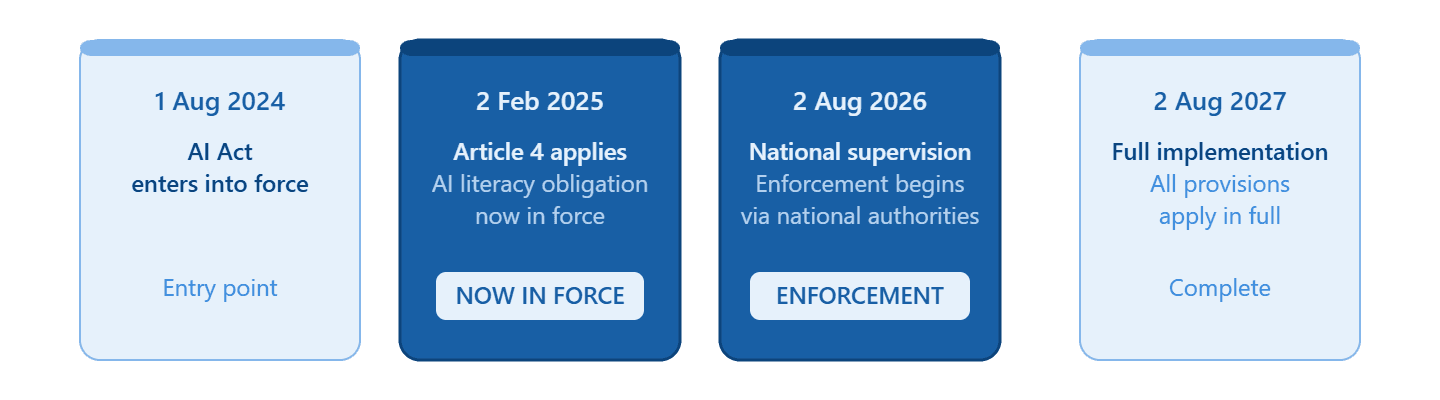
At the same time, the regulatory environment has shifted. Article 4 of the EU AI Act has applied since 2 February 2025. AI literacy is not a future obligation for federations deploying AI systems on athletes. It is a present one, with documentation requirements, procurement implications and a national enforcement layer that turns on in August 2026.
These two realities, a maturing evidence base on athlete mental health and a tightening regulatory frame on AI tools, are converging. The sector is not ready for what happens when they meet.
Signal 1: The AI Literacy Clock Is Already Ticking
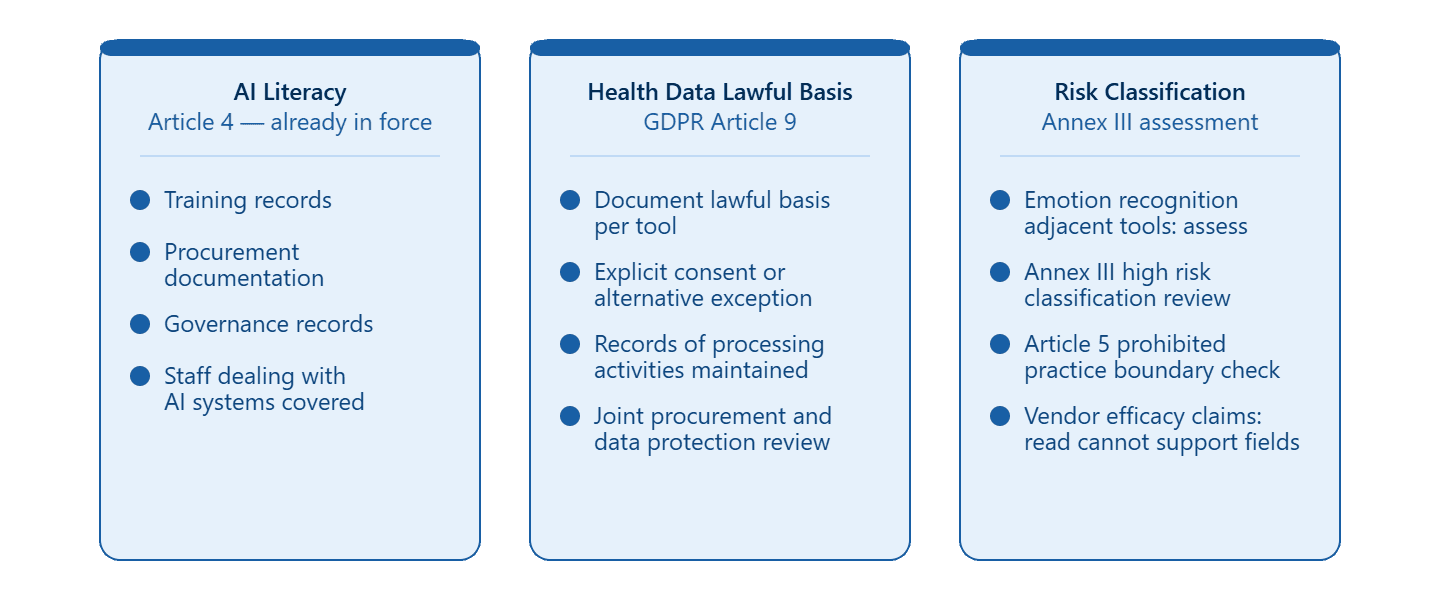
The EU AI Act entered into force on 1 August 2024 and applies in stages. Article 4 requires providers and deployers of AI systems to ensure a sufficient level of AI literacy among staff dealing with those systems. Where federations or clubs use AI systems in mental health screening, athlete monitoring or AI-mediated coaching feedback, they may need to assess whether they act as deployers under the Act.
For federations and national governing bodies in the EU and EEA, the practical consequence is that an AI literacy programme should already be in place and documented through training records, procurement documentation and governance records. The most common gap this scan finds is not resistance. It is absence of awareness that the obligation is already running.
Signal 2: The Numbers Do Not Let Federations Look Away
The frequently cited 25 to 40 per cent range for mental health symptoms in elite sport should be read as a directional range across selected audited sources, not as a single pooled prevalence estimate. Rates vary by disorder, measurement tool, population and time window. None of the audited sources ground clinical diagnosis rate claims; they are symptom self-report or screen-positive rates.
What this base supports is the institutional claim that athlete mental health is a population level welfare issue, not anecdotal. What it does not yet support is a clinical-grade picture of female athlete prevalence, nor a longitudinal picture beyond football. Both are scan limitations carried forward.
Signal 3: Procurement Is Moving Faster Than the Paperwork
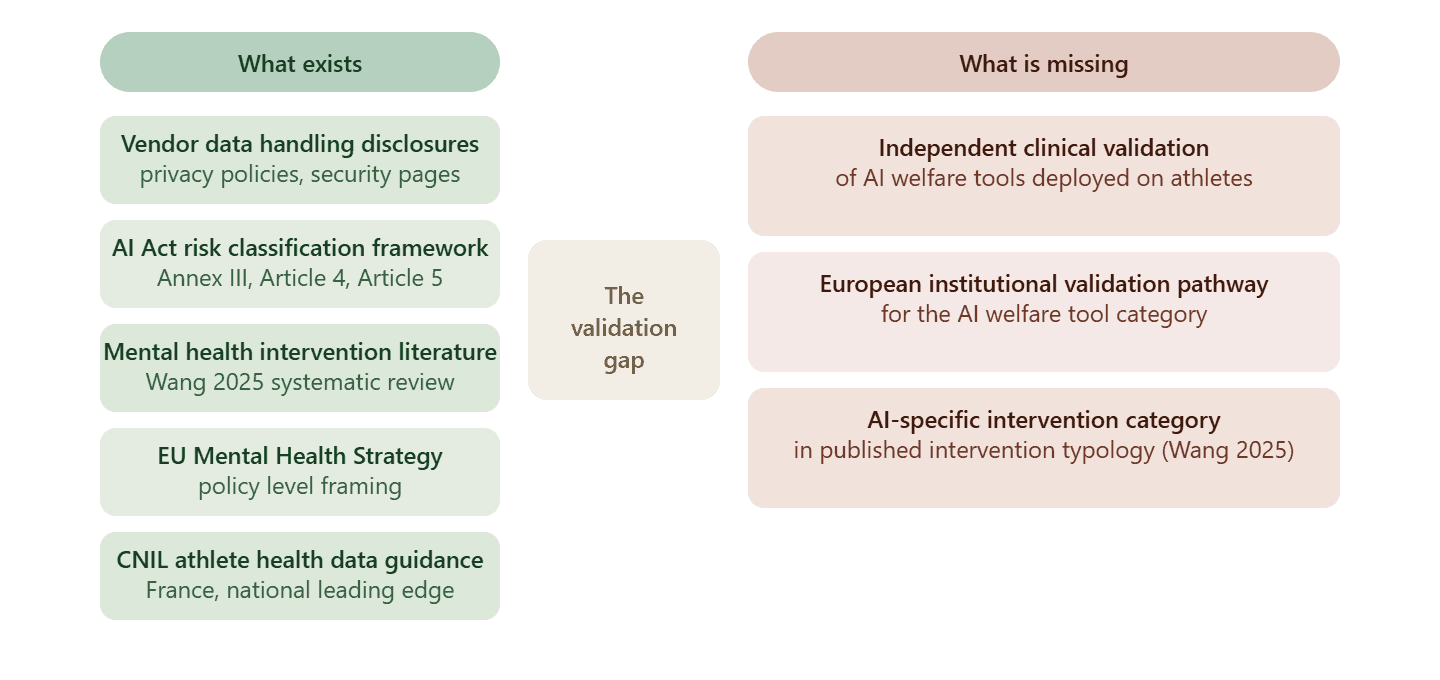
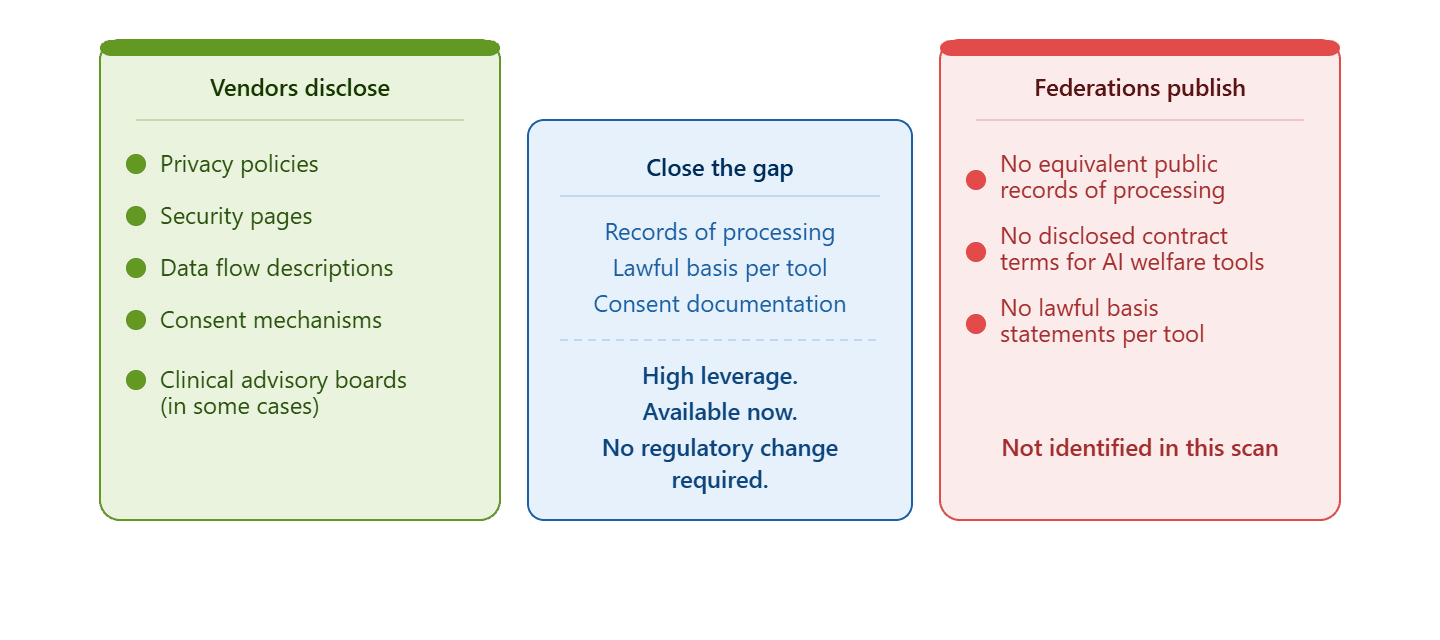
AI welfare and monitoring tools are increasingly marketed and deployed in professional sport contexts. No equivalent federation-side public disclosure of contract terms, data flows or consent mechanisms for the AI welfare tool category was identified in this scan. Vendor disclosure is not the same as federation procurement. The gap between the two is where exposure concentrates.
Signal 4: Annex III May Be Closer Than Federations Think
AI systems that infer emotion, distress or welfare risk from athlete data may require regulatory classification assessment under the AI Act, even where the deployment is welfare framed. The AI Act's Annex III high risk categories include emotion recognition. The classification debate is genuinely unresolved. A federation procuring an emotion recognition or emotion inference adjacent welfare tool may need to assess whether the system falls within Annex III high risk categories, Article 5 prohibited practice boundaries, another AI Act pathway, or a medical device regulatory pathway.
Following the 7 May 2026 provisional Digital Omnibus agreement, the planning horizon for Annex III stand-alone high risk systems appears to move toward 2 December 2027, subject to formal adoption.
Signal 5: Player Unions Are More Visible Than Federations
FIFPro's mental health programme materials and the World Players Association's rights framework are the two most developed player-side institutional positions in this scan's audited base. In the audited public evidence base for AI-mediated welfare, player unions are more visible than federations. Player unions have moved into the welfare conversation faster because the legal incentive for them is clearer. Their members are the people whose data is being processed. Closing the gap requires federations to see this conversation as theirs, not the unions' alone.
Three Trends Shaping the Landscape
A regulatory perimeter is closing. Article 4 of the AI Act, GDPR Article 9, CNIL's athlete health data guidance and the Annex III classification debate together create a tightening compliance frame for federations using AI mental health, emotion inference or athlete monitoring tools. The trend says the perimeter is closing; it does not say any specific federation or tool is currently in breach.
Procurement is outrunning disclosure. Vendors disclose data handling terms. Equivalent federation-side disclosure was not identified in this scan. Where that asymmetry exists, exposure may concentrate at the federation when a procurement becomes contested.
The evidence has matured ahead of the institutional response. The five-source feeder base, the IOC consensus, the Gouttebarge meta-analysis, the Pillay cohort, the FIFPro programme and the Henriksen ISSP consensus, supports the population level welfare framing. Federation level pathways have not adapted at the same pace.
The Gap: No Independent Validation Layer
This is the structural finding of the scan. Independent peer-reviewed clinical validation of AI-mediated mental health screening or intervention tools deployed on athletes was not identified. In the Wang et al. 2025 systematic review of psychological interventions for elite athlete mental wellbeing, AI-mediated tools do not appear as a substantial intervention category. No widely adopted European institutional validation pathway was identified for the elite sport AI welfare tool category.
The risk if this gap is unaddressed runs in two directions. Federation level reputational exposure if an undisclosed procurement becomes the subject of a non-compliance challenge. And sector level exposure if athletes who relied on the tool report no benefit or harm, and the absence of validation evidence becomes the story.
The Gap is not a research absence. It is a coordination absence. It is achievable to close, and the institutions that move first will shape what acceptable practice looks like for the next decade.
Two Wild Cards to Watch
Wild Card 1: A national regulator opens an Article 4 or Article 9 enforcement action against a European federation over the data flows of an undisclosed AI welfare tool deployment. Probability: low, below 50 per cent within the next two years. Impact if it happens: sector-wide acceleration of compliance audits. Key tension: procurement pace versus disclosure readiness.
Wild Card 2: A major AI welfare tool vendor publicly withdraws a clinical or efficacy claim after independent academic or regulator challenge. Probability: low, below 50 per cent within the next two years. Impact if it happens: category transformation across vendor positioning. Key tension: vendor framing versus independent validation.
Both are scenario assessments, not predictions.
So What Now?
Three priority areas emerge from the analysis.
Procurement discipline. Treat Article 4 AI literacy as already in force. Document training records, procurement decisions and governance arrangements. Jointly assess lawful basis under GDPR Article 9 for every tool that processes athlete health data. Anticipate that emotion recognition adjacent systems may require Annex III classification assessment.
Disclosure parity with vendors. Records of processing activities, lawful basis statements per tool and consent mechanism documentation are the artefacts that come into question first when a procurement becomes contested. Closing this gap is high leverage and requires no regulatory change to begin.
Independent validation pathways. The EU institutional layer, member state data protection authorities, research funders, player unions and sport science institutions could commission independent validation studies of the AI welfare tool category. Until that work exists, federations procure ahead of independent evidence and accept the exposure that creates.
The five year picture is not yet visible. The two year picture is the one to plan for.
Sport Singularity writes these scans for federations, clubs and policy partners who need a working picture of where the operating environment is heading, without being asked to commit to a vendor or a programme to receive it. Our role is to map the perimeter clearly enough that the institutions inside it can decide what they want to build, with whom, and on what evidence.
This article is a part of the SF4Sport Strategic Foresight Series by Sport Singularity. The analysis draws on 22 audited sources across peer-reviewed research, regulatory text and institutional reports (2019 to 2026), and maps European policy frameworks including the EU AI Act, GDPR Article 9 and CNIL athlete health data guidance...
May 2026, Sport Singularity, SF4Sport
Bibliography
Primary regulator and policy text
P1. European Parliament and Council. (2024). Regulation (EU) 2024/1689 laying down harmonised rules on artificial intelligence (Artificial Intelligence Act). Official Journal of the European Union. https://eur-lex.europa.eu/eli/reg/2024/1689/oj
P2. European Parliament and Council. (2016, consolidated through 2024). Regulation (EU) 2016/679 (General Data Protection Regulation), Article 9 on processing of special categories of personal data. Official Journal of the European Union. https://eur-lex.europa.eu/eli/reg/2016/679/oj
P3. European Commission. (2023). Communication on a comprehensive approach to mental health. COM(2023) 298 final. https://eur-lex.europa.eu/legal-content/EN/TXT/?uri=COM:2023:298:FIN
P4. Council of Europe. (2018, modernised). Convention 108+ — Convention for the Protection of Individuals with regard to the Processing of Personal Data, ETS No. 223. https://www.coe.int/en/web/data-protection/convention108-and-protocol
P5. World Health Organization. (2022). World Mental Health Report: Transforming Mental Health for All. Geneva: WHO. https://www.who.int/publications/i/item/9789240049338
R1. Commission nationale de l'informatique et des libertés (CNIL). La collecte de données pour la mesure de la performance physique individuelle des sportifs de haut niveau ou professionnels.
R2. Commission nationale de l'informatique et des libertés (CNIL). Dans quels cas et à quelles conditions des données de santé peuvent-elles être collectées sur les sportifs ?
Institutional reports
P6. European Commission DG EAC, SHARE 2.0 Initiative. (2025, September). Artificial Intelligence in the Sports Sector. Publication of the European Union.
I2. FIFPro World Players' Union. Mental Health Programme. https://fifpro.org/en/supporting-players/health-and-performance/mental-health
I5. World Players Association (UNI Global Union). https://www.uniglobalunion.org/sectors/world-players/
Academic sources
A1. Reardon, C. L., et al. (2019). Mental health in elite athletes: International Olympic Committee consensus statement (2019). British Journal of Sports Medicine, 53(11), 667 to 699. DOI: 10.1136/bjsports-2019-100715
A2. Gouttebarge, V., et al. (2019). Occurrence of mental health symptoms and disorders in current and former elite athletes: a systematic review and meta-analysis. British Journal of Sports Medicine, 53(11), 700 to 706. DOI: 10.1136/bjsports-2019-100671
A3. Henriksen, K., et al. (2020). Consensus statement on improving the mental health of high performance athletes. International Journal of Sport and Exercise Psychology, 18(5), 553 to 560. DOI: 10.1080/1612197x.2019.1570473
A4. Wang, M.-T., Schweickle, M. J., Arnold, R., Vella, S. A. (2025). Psychological Interventions to Improve Elite Athlete Mental Wellbeing: A Systematic Review and Meta-analysis. Sports Medicine, 55(4), 877 to 897. DOI: 10.1007/s40279-024-02173-3
A5. Pillay, L., et al. (2024). Don't forget to mind the mind: a prospective cohort study over 12 months on mental health symptoms in active professional male footballers. BMC Sports Science, Medicine and Rehabilitation, 16(1). DOI: 10.1186/s13102-024-01005-1
A6. Westerbeek, H., van Schaik, P. (2025). Platform power, athlete branding, generative AI, and the future of sport governance — a systematic review. Frontiers in Sports and Active Living, 7. DOI: 10.3389/fspor.2025.1642180
Quality journalism
J1. Sky Sports. FIFPro survey reveals mental health concerns for footballers. https://www.skysports.com/football/news/19024/10019698/fifpro-survey-reveals-mental-health-concerns-for-footballers
J2. ESPN. One in four footballers depressed, says study. https://www.espn.com/soccer/story/_/id/37347249/more-quarter-professional-footballers-suffer-depression-anxiety-problems-according-fifpro-study
J3. Columbia Journalism Review. Simone Biles, Naomi Osaka, and the media's coverage of mental health in sports. https://www.cjr.org/the_media_today/biles_osaka_olympics_mental_health.php
J4. Tech Policy Press. Europe's Regulatory Failure on Generative AI and Mental Health. https://www.techpolicy.press/europes-regulatory-failure-on-generative-ai-and-mental-health/
Industry and vendor disclosure
V2. Headspace. Privacy Policy. https://www.headspace.com/privacy-policy
V4. Catapult. Privacy Policy. https://www.catapult.com/privacy-policy