Is Padel Growing - Or Just Being Built?
Author: G.Aydin, H.Ege

This is a Sport Singularity strategic foresight report: it reads the signals already shaping European sport, sets out the plausible futures they point to, and turns them into practical choices for clubs, federations and public bodies.
Is Padel Growing Or Just Being Built?
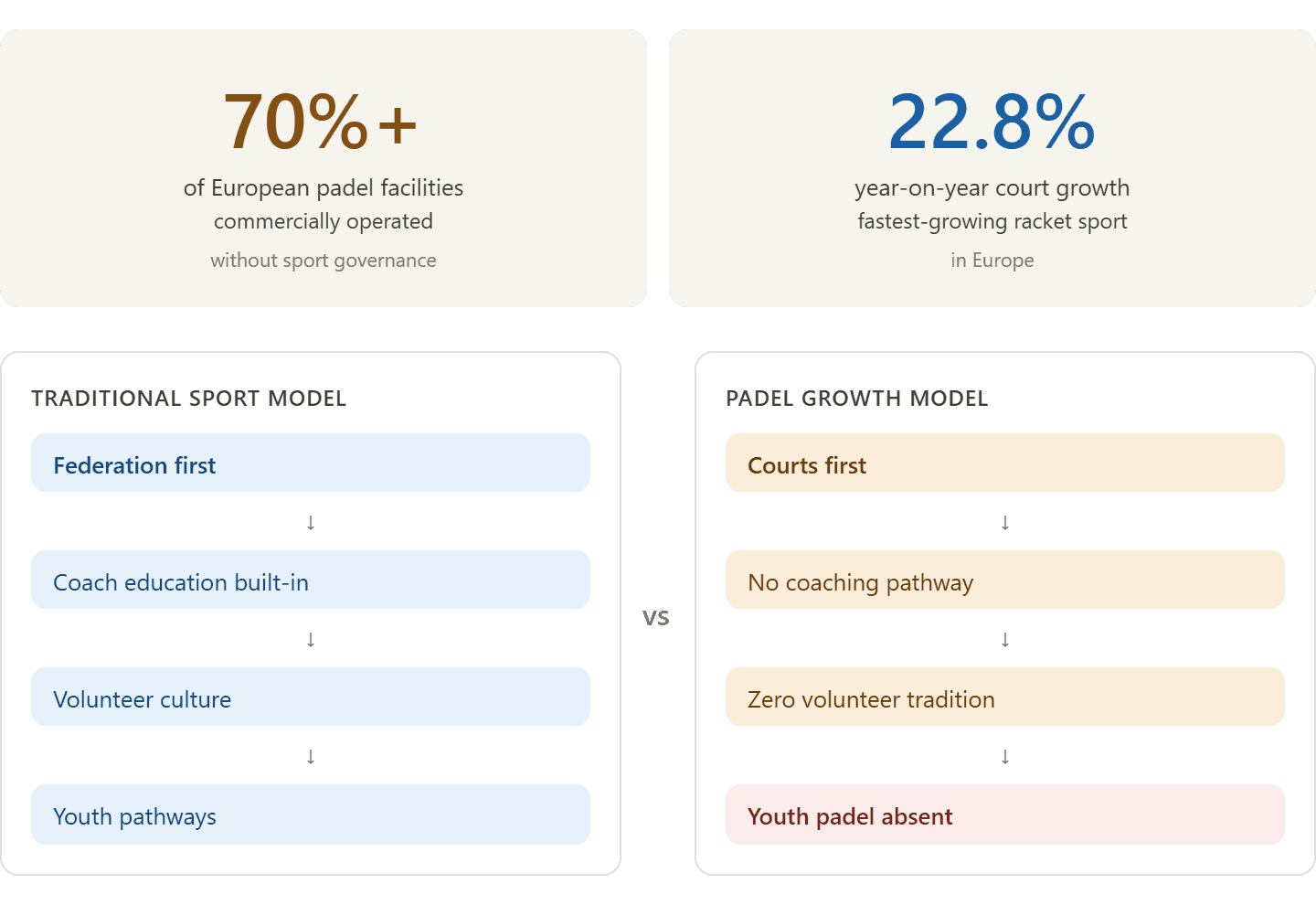
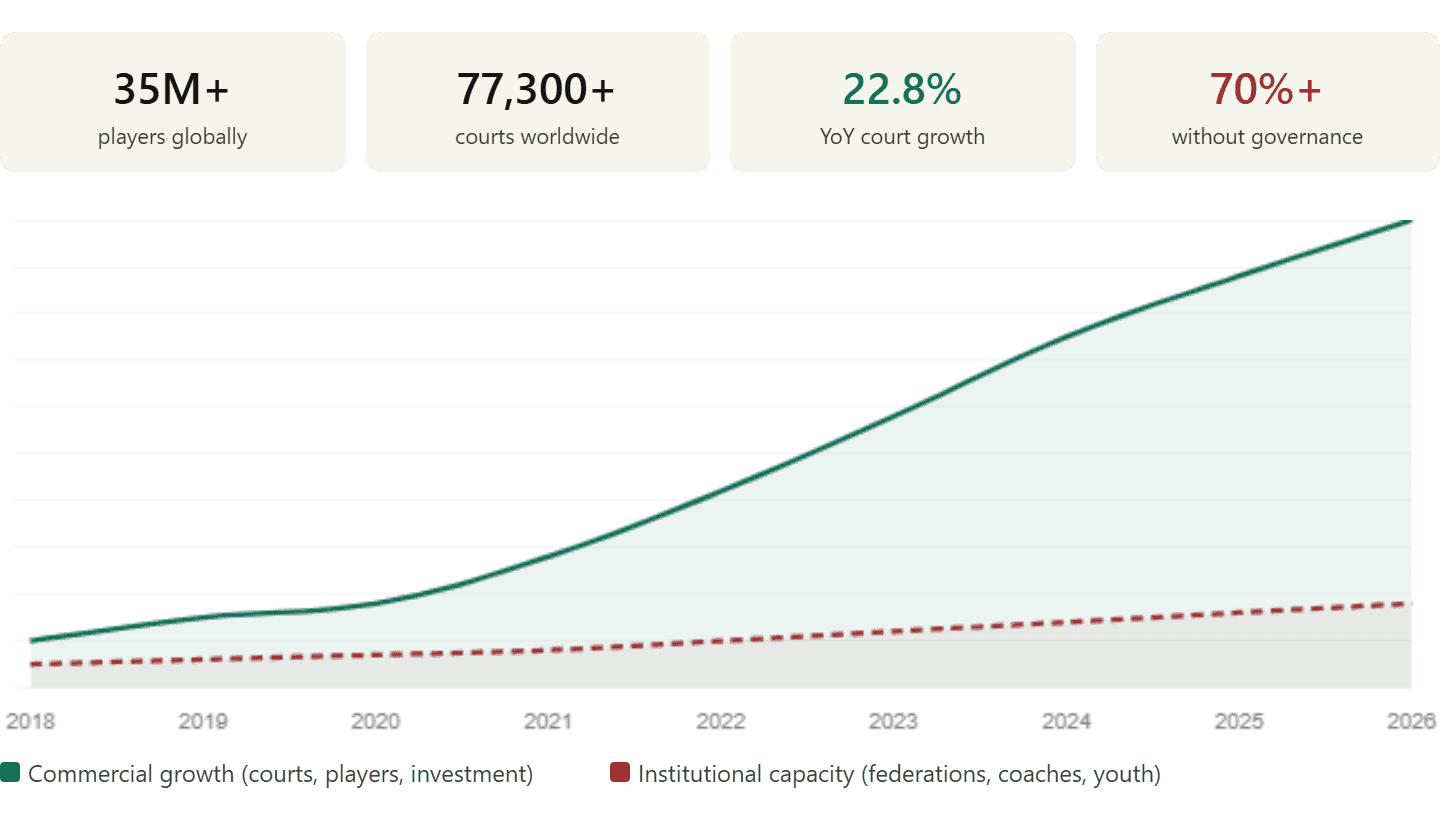
Padel is Europe's fastest-growing racket sport. With over 35 million players across 77,300+ courts and 22.8% year-on-year growth, it has moved from niche to mainstream in under a decade. But this expansion is structurally imbalanced: over 70% of facilities are commercially operated without sport governance, organised youth padel is virtually absent, and emerging regions see courts built but no institutions behind them.
Using our SF4Sport methodology, the work involved three interconnected layers:
Environmental scanning: identifying signals of change, emerging trends and potential wild cards across the grassroots padel development landscape in Europe.
Policy alignment: mapping these findings against EU policy frameworks including Erasmus+ Sport 2026, the European Sport Model resolution, and the FIP Academy certification framework.
Evidence synthesis: reviewing 15+ sources published between 2020 and 2026, alongside federation data, industry reports and policy documents from FIP, national federations and the European Commission.
The picture that emerged reveals a sport at a crossroads. Here are 5 signals, 3 trends and 2 wild cards likely to shape the future of grassroots padel development in Europe.
Signal 1 - Courts Are Built, But Institutions Are Not
Over 70% of European padel facilities are commercially operated without sport governance structures. Courts are being built at record speed, but federations, coaching systems, and youth pathways are not following. In emerging markets across the Balkans and Eastern Europe, court construction is booming while federation capacity remains minimal, no coach education systems, no structured development frameworks, no volunteer infrastructure.
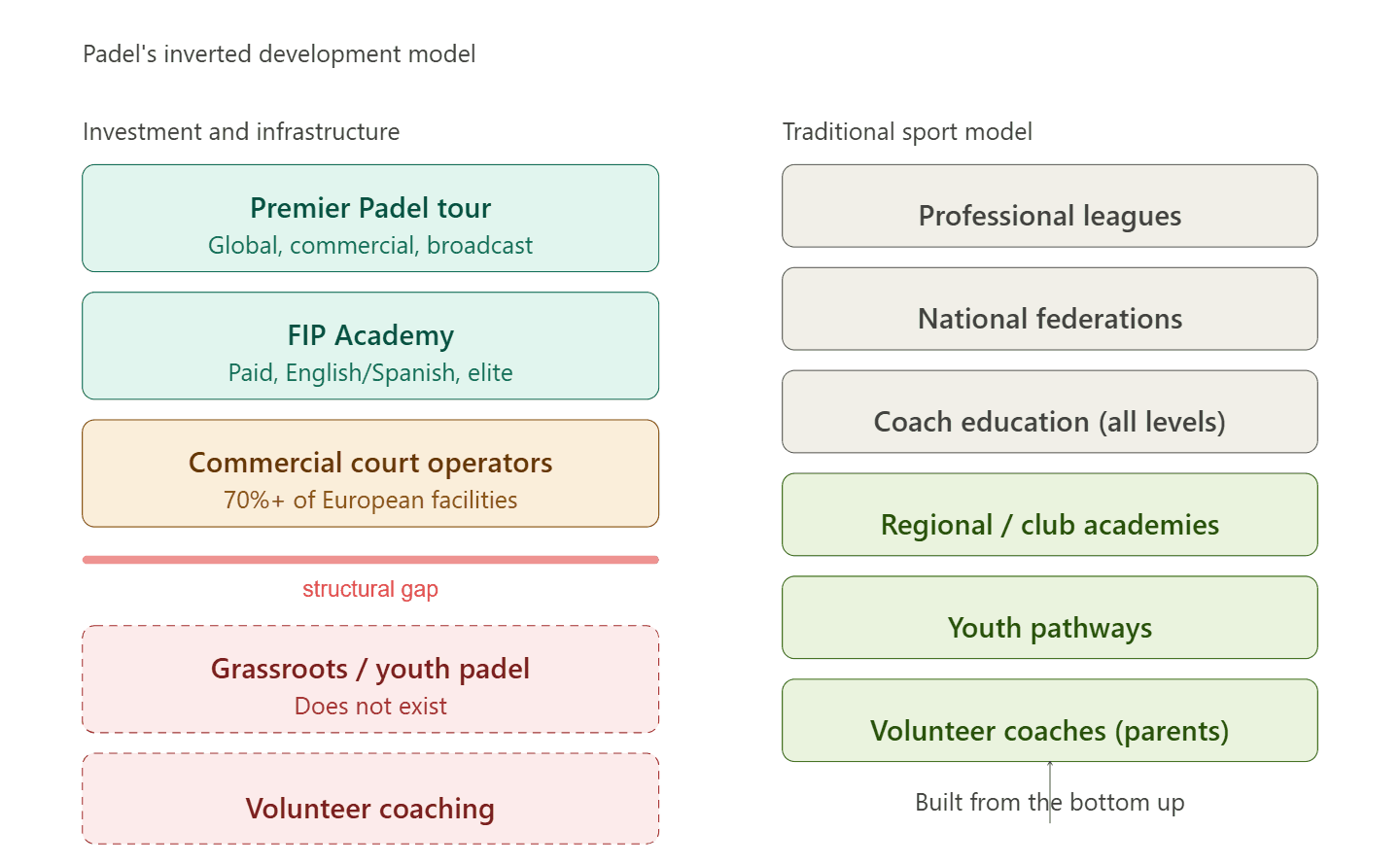
This creates what we call the "padel growth paradox": the sport's commercial engine is running far ahead of its institutional foundation. In traditional European sport, the sequence was federation first, then coach education, then volunteer culture, then youth pathways. Padel reversed this entirely, courts first, everything else later. Or never.
The sport is being built commercially. It is not yet growing institutionally.
Signal 2 - Women Are 40% of Players But Less Than 10% of Leaders
Around 40% of padel players are women, an exceptional ratio in racket sports. Yet fewer than 10% of coaches, managers, and federation board members are female. This is the "gender paradox" of padel: high participation, near-total absence at the decision-making level. The barrier is structural, there are no pathways for women to transition from playing into coaching, governance, or leadership roles.
Unlike many sports where the challenge is getting women to participate, padel has already achieved that. The pipeline is full. The pathway is blocked.
Women play padel. They do not yet lead it.
Signal 3 - An Adult Sport With No Youth Pathway
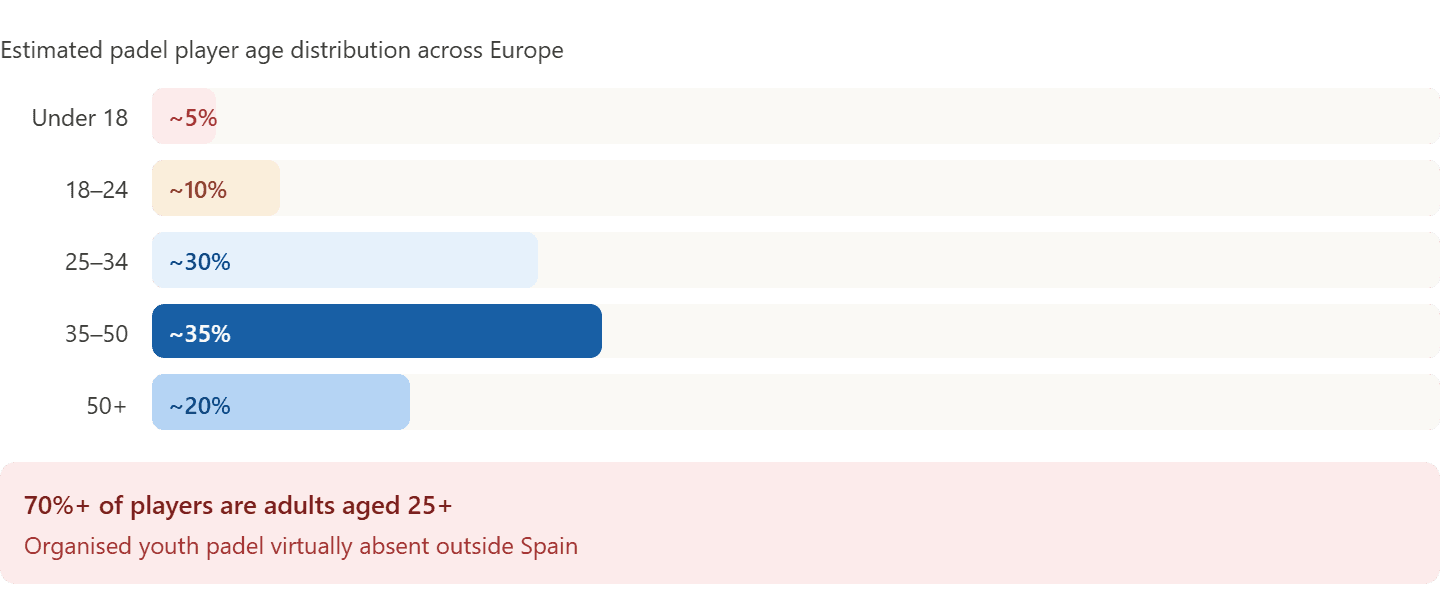
Over 70% of padel players are adults aged 25 and above. Organised youth padel is virtually absent outside a single established market, no development frameworks, no junior competitions, no age-appropriate coaching methodologies. Yet in Northern Europe, 90% of grassroots sport coaches are volunteer parents. Padel's adult demographic, predominantly 30–50 year-old parents who already play, represents a massive untapped coaching workforce. What is missing is a structured pathway.
The age distribution tells the story clearly. An estimated 85% of players are aged 25 and above. Under-18 participation sits at roughly 5%. This is not a sport with a youth problem, it is a sport that has never built a youth foundation.
The parents are already playing. They just have no pathway to coach their children.
Signal 4 - European Sport Runs on Volunteers. Padel Has None
Unlike football, handball, or athletics, padel has no volunteer coaching tradition whatsoever. In Norway alone, 90% of grassroots coaches are unpaid parent-volunteers. Padel's commercial model bypassed this entirely, courts were built as business ventures, not community sport infrastructure. The result: no parent-coach pathway, no volunteer mobilisation, no grassroots workforce.
This is not a minor gap. It is the absence of the engine that drives youth sport development across Europe. Every established European sport, from football to swimming to handball, runs on the labour of parents who volunteer as coaches, administrators and event organisers. Padel has no equivalent.
The engine of European grassroots sport does not exist in padel.
Signal 5 - Coach Education Exists at the Top. Not at the Base
The launch of FIP Academy (December 2025) and Premier Padel Academy (February 2026) are landmark developments for professional coach certification. However, these programmes serve the elite layer: they are paid, primarily available in English and Spanish, and target existing coaches seeking international accreditation.
What does not exist anywhere is a free, multilingual, grassroots-focused programme that trains volunteers, community leaders, and aspiring coaches in their own languages. The base of the coaching pyramid is completely empty. Countries in the Balkans and Eastern Europe where padel is growing have no access to structured coach education at any level.
When compared to other European sports, the contrast is stark. Football offers extensive volunteer coaching pathways. Handball and swimming have established systems. Athletics has moderate provision. Padel has none.
FIP Academy certifies the peak. Nobody is building the base.
Trend 1 - Padel's Gender Paradox Is Structural
Padel stands out for its high female participation, approximately 40%. Yet this has not translated into power: women are near-absent from coaching, federation boards, and strategic decision-making. As padel professionalises, existing gender imbalances risk being reproduced. Without deliberate intervention, leadership pathways, coaching pipelines, governance quotas, padel will follow the pattern of every other sport where women play but do not lead.
The gap between commercial growth and institutional capacity is widening year on year. Since 2018, courts, players and investment have grown exponentially. Institutional capacity, federations, coaches, youth structures, has barely moved.
The window to intervene is now. Once governance structures solidify without women, changing them becomes exponentially harder.
Trend 2 - Courts Without Federations
Countries across the Balkans, Eastern Europe, and the Eastern Mediterranean are seeing rapid padel court construction in an institutional vacuum: minimal federation capacity, no coach education, no development frameworks. Without intervention, these markets will develop padel as a purely commercial product, adult entertainment with no youth pathway and no safeguarding standards.
With strategic support, however, these markets could leapfrog traditional models entirely. They do not carry the legacy structures and institutional inertia of established markets. Given the right tools, federation capacity building toolkits, multilingual training resources, digital platforms, emerging markets could build inclusive, governance-ready padel ecosystems from the start.
The emerging markets are a blank canvas. What gets drawn now will define the sport for decades.
Trend 3 - Professionalisation Without Democratisation
The rapid professionalisation of padel, Premier Padel tour, FIP Academy, commercial investment, is creating a top-heavy ecosystem. Elite structures are being built without corresponding grassroots investment. Unlike football or basketball, where professional leagues grew out of community sport, padel built the elite product first. The grassroots layer was never the starting point, and unless deliberately constructed, it will not emerge organically.
This trend mirrors a wider pattern in sport: professionalisation often accelerates at the elite level while grassroots infrastructure stagnates. In padel, the risk is amplified because the sport never had a grassroots tradition to begin with. The entire development model is inverted.
Padel is professionalising from the top. It needs to democratise from the bottom.
The Opportunity - Sport Capacity Building Tools Exist. Adapting Them to Padel Is the Next Step
Sport-based capacity building programmes have a proven track record across traditional sports. Volunteer mobilisation, coach education, youth pathways, gender equality initiatives, these tools work. They have been validated by decades of evidence across football, handball, athletics, and swimming. Padel offers a unique opportunity to adapt and apply these proven tools. A "Level 0" volunteer coach programme, designed as a feeder pathway to existing FIP Academy levels. A free, multilingual training entry point. A youth development framework tailored for emerging markets. A women-in-leadership programme that builds on padel's strong participation base. The tools exist in other sports; the opportunity now is to design padel-specific versions that complement and extend the professional infrastructure already in place
Wild Card 1 - What If a Federation Goes from 45 to 285 Clubs in 4 Years?
A wild card is a low-probability, high-impact event that could disrupt the entire landscape overnight.
This is not a hypothetical, it has already happened in one major European market. A national padel federation grew from 45 to 285 registered clubs in just four years. This kind of explosive growth, if replicated across emerging markets, could transform padel's grassroots landscape within a single EU funding cycle.
But rapid federation growth also carries risks: governance challenges, quality control issues, safeguarding gaps, and the risk of commercial interests dominating volunteer-driven structures. The question is whether this growth can be channelled into sustainable, inclusive, community-based sport, or whether it will simply add volume without substance.
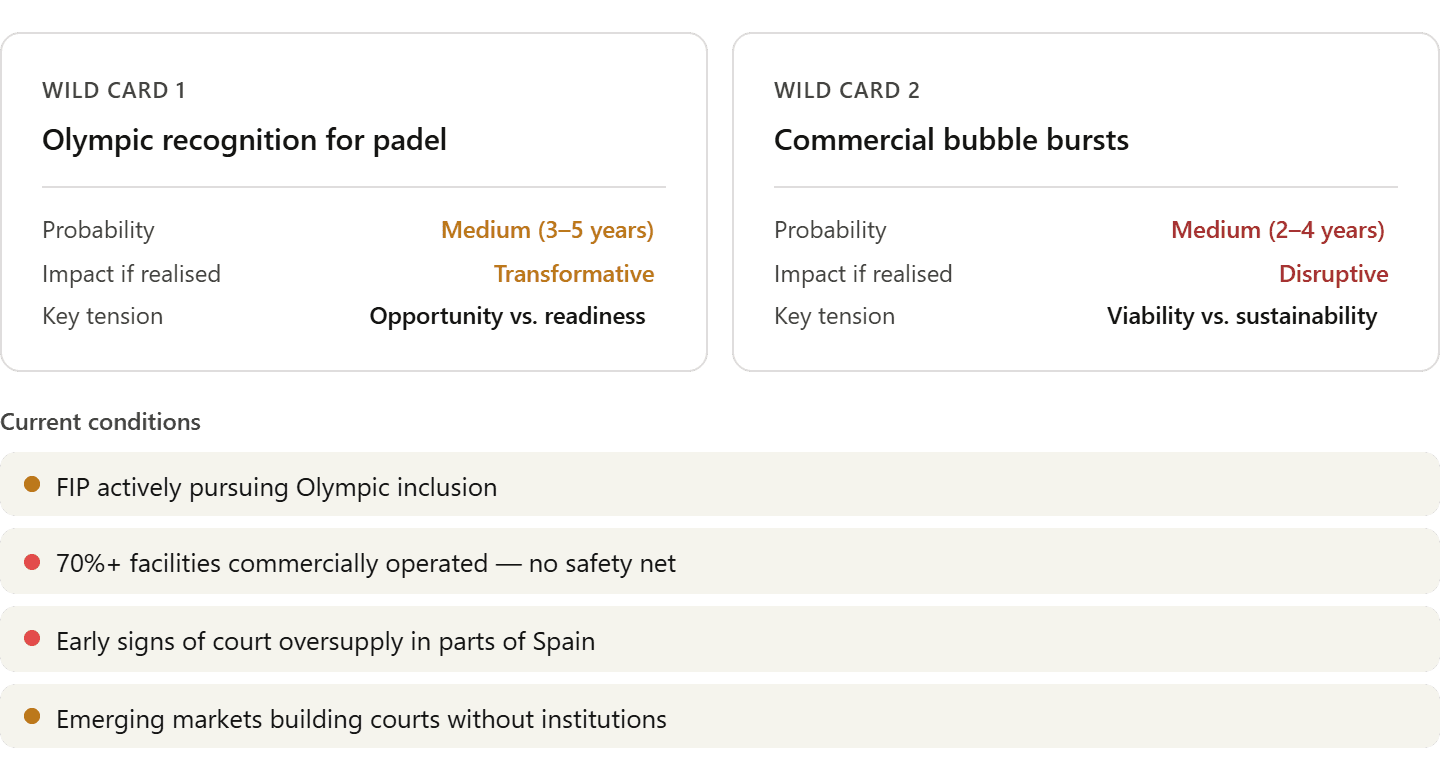
The probability is medium, within a 3–5 year window. The impact, if realised, would be transformative. The key tension is between opportunity and readiness.
Explosive growth without governance is not development. It is expansion without foundation.
Wild Card 2 - What If Padel's Commercial Bubble Bursts?
Padel's court boom is driven by commercial investment, not sport policy. If the model proves unsustainable, market saturation, declining ROI or economic downturn, courts could close as fast as they opened. Without federation ownership or public funding, there is no safety net. In parts of Southern Europe, early signs of court oversupply have already emerged. If this repeats across newer markets, facilities could disappear before institutions are built to sustain them.
The probability is medium, within a 2–4 year window. The impact would be disruptive. The key tension is between commercial viability and institutional sustainability.
Current conditions amplify the risk: FIP is actively pursuing Olympic inclusion, 70%+ of facilities are commercially operated with no safety net, early signs of court oversupply are appearing, and emerging markets are building courts without institutions.
A sport built on commercial investment alone is a sport without a safety net.
So What Now?
These signals and trends make one thing clear: padel's grassroots foundation needs deliberate construction, it will not build itself.
Three priority areas emerge from the analysis:
Priority 1 - Volunteer Coach Mobilisation
Padel needs a "Level 0" pre-entry coaching programme: free, multilingual, designed for parents who already play padel and already volunteer in other sports. This programme should sit below FIP Academy, creating the base of the coaching pyramid. It should be deliverable by any club without external support, a "programme in a box" that can be downloaded, translated and implemented.
This aligns with the Erasmus+ 2026 Programme Guide's priorities on encouraging sport and physical activity, and with the European Sport Model's emphasis on grassroots infrastructure.
Priority 2 - Women in Padel Leadership
The gender paradox is the single most obvious structural gap in the sport. A dedicated Women in Padel Leadership programme should address coaching pathways, governance representation and strategic decision-making. The target is clear: close the gap between 40% participation and less than 10% leadership.
This aligns directly with the Erasmus+ 2026 priority on promoting gender equality in sport.
Priority 3 - Emerging Market Federation Capacity
Countries where padel is growing need a "federation in a box": step-by-step guidance from legal registration to first national tournament. This toolkit should include governance models, membership systems, growth roadmaps and safeguarding standards, all available in multiple languages and adaptable to local contexts.
This aligns with the Erasmus+ objective of building sport governance capacity in emerging European markets.
EU policy alignment
Our analysis found strong alignment between these findings and active EU policy frameworks. The strongest connections run through Erasmus+ Sport 2026 (Cooperative Partnerships, priorities on encouraging participation, gender equality, integrity and values, social inclusion, digital dimension), the European Sport Model resolution (adopted October 2025 by the European Parliament with 86% majority), FIP Academy and Premier Padel Academy certification frameworks, and TFEU Article 165 on developing the European dimension in sport.
The convergence of padel's explosive growth with the 2026–2028 EU sport policy window creates a unique and urgent opportunity for action.
This article is a part of the SF4Sport Strategic Foresight Series by Sport Singularity. The analysis draws on 15+ sources (2020–2026) and maps EU policy frameworks including Erasmus+ Sport 2026, the European Sport Model, and the FIP Academy framework.
April 2026, Sport Singularity, SF4Sport